
A guest post by Sandy Rushton, People Powered Retrofit. Originally featured on Medium.
On October 25th, 2023, the Energise Manchester project team met to carry out an Intervention Mapping workshop. The workshop was facilitated by Chandni Patel and Val Mitchell from Snook, with support from me and Lorenza Casini.
This was one of the first project-wide activities in the Behaviour Change Design process; in this post, I’ll talk about the aims and objectives, what we did, and some of the outcomes and reflections from the session.
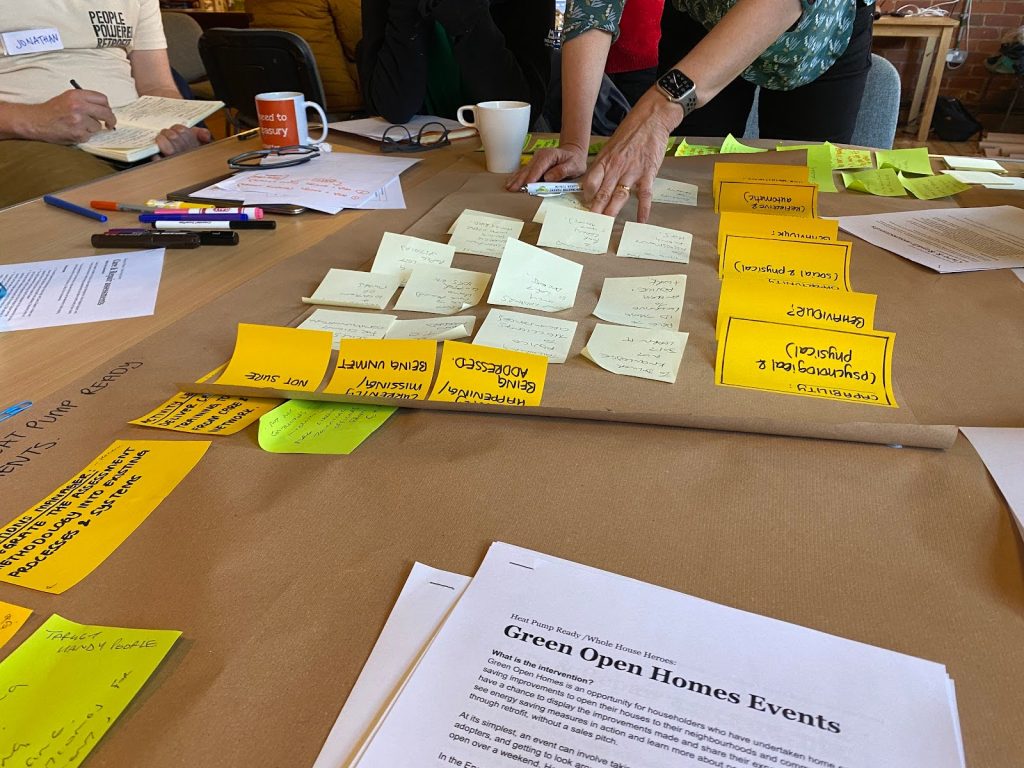
Our project team met to carry out an Intervention Mapping workshop. The workshop was facilitated by Chandni and Val from Snook, with support from me. This was one of the first project-wide activities in the Behaviour Change Design process; in this post, I’ll talk about the aims and objectives, what we did, and some of the outcomes and reflections from the session.
Aims and objectives
As I mentioned in my previous post, the Energise Manchester project partners are already delivering a range of interventions that are relevant to energy advice.
In this workshop, we aimed to identify critical target behaviours for each intervention that we are set to deliver in the first few months of this project. We wanted to understand what people are doing now and/or what we want them to do as a result of this intervention. This includes the audience for the intervention, as well as other actors involved in or affected by delivery.
We also wanted to prioritise the target behaviours and confirm which target behaviours we wanted to focus on for each key message.
This was an ambitious set of objectives for a 5-hour workshop, so we decided to focus primarily on two of our project’s themes: Warm for Winter and Heat Pump Ready.
Preparing for the workshop
To prepare for the workshop, we started mapping out the interventions that we were going to look at in the session. Chandni created a Mural board with a table where others could fill in some information about each intervention, including:
- A short summary of the intervention.
- The purpose of the intervention; what do we want it to achieve, for whom, and why.
- The people involved in delivery and the target audience.
- An outline of the critical steps/actions in delivering this intervention.
- Target behaviours; what people will do as a result of this intervention.

Documenting this information in advance of the workshop gave Chandni and Val time to structure their materials for the workshop. It also meant that we would save time in the workshop as the attendees would be able to respond to a draft of the intervention map; they wouldn’t have to start from scratch.
We also pulled out some key topics from the list of energy efficiency behaviours that Marianne had previously outlined for each of our project’s thematic areas. We brought those topics (e.g. fabric, ventilation, planning, monitoring) into the workshop to help us better understand how each intervention relates to the different steps in the process of carrying out energy efficiency works and identify any gaps.
What we did in the workshop
The workshop was attended by project team members from Carbon Coop, Manchester Care & Repair, People Powered Retrofit, and Shortwork.
After a short introduction to the workshop context, aims and format, we split into two groups to review and build on the pre-prepared intervention maps. Lorenza and I supported Chandni and Val by summarising and introducing the intervention, and walking through the steps. Chandni and Val then facilitated a review of the intervention map. Key questions we focused on were:
- Which energy efficiency topics does this intervention relate to? (e.g. ventilation, heating etc)
- What steps are missing?
- What other people are involved?
- What do we want people to do as a result of this intervention? Are the target behaviours correct? How can we make them more explicit and specific?
- What are the most critical target behaviours?
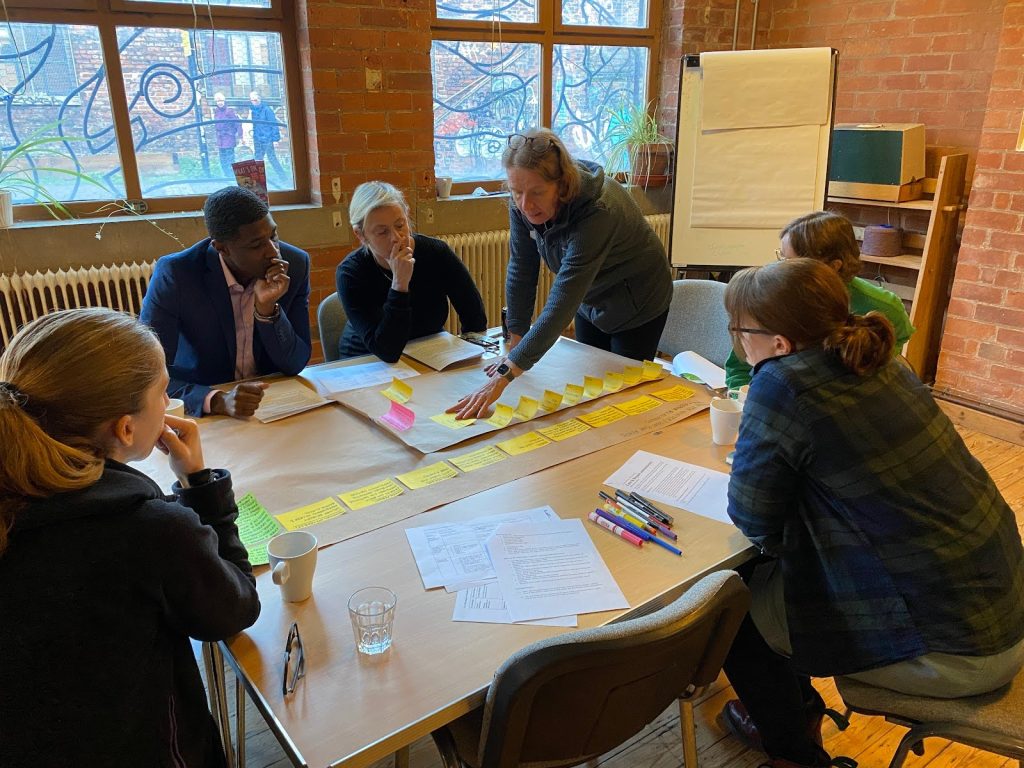
Once interventions had been mapped out, we looked at the list of topic areas that Marianne had listed in her presentation on energy efficiency areas and identified which topic areas were relevant to each intervention. For example, ‘Energy Training events/workshops at Community Hubs’ was linked to Air-Tightness, Draught-proofing, Indoor air quality/ventilation, Heating, and Fabric.
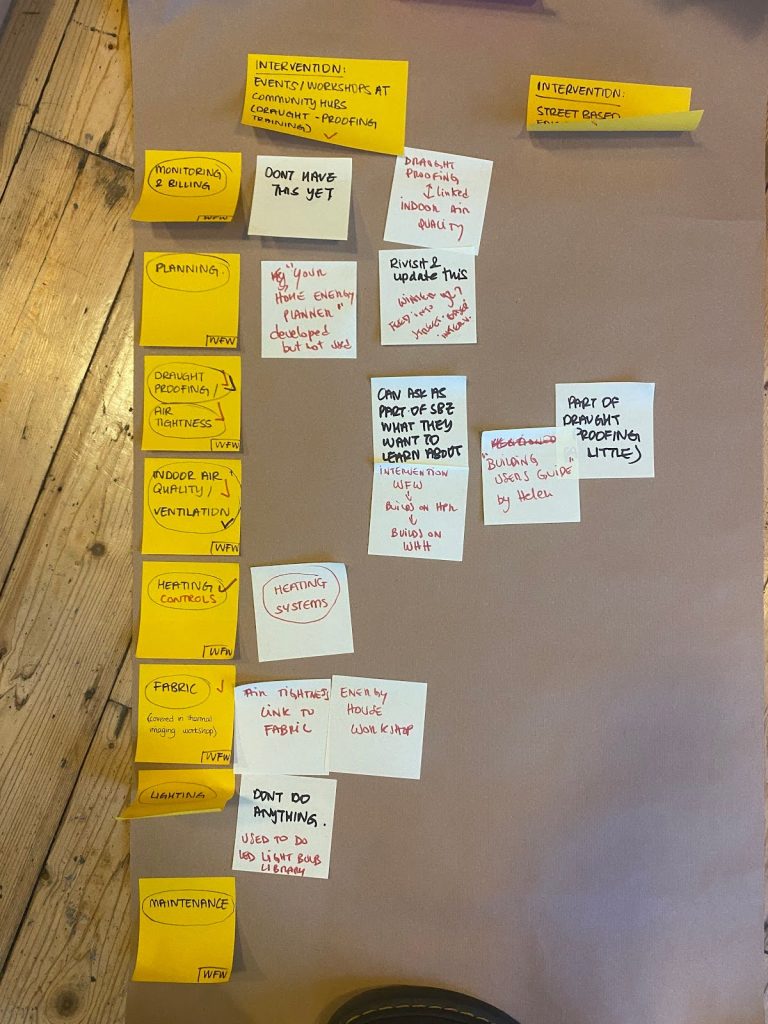
In most cases, multiple topics were covered by each intervention; this was expected given the partners’ holistic and whole-house approaches to retrofit and energy efficiency.
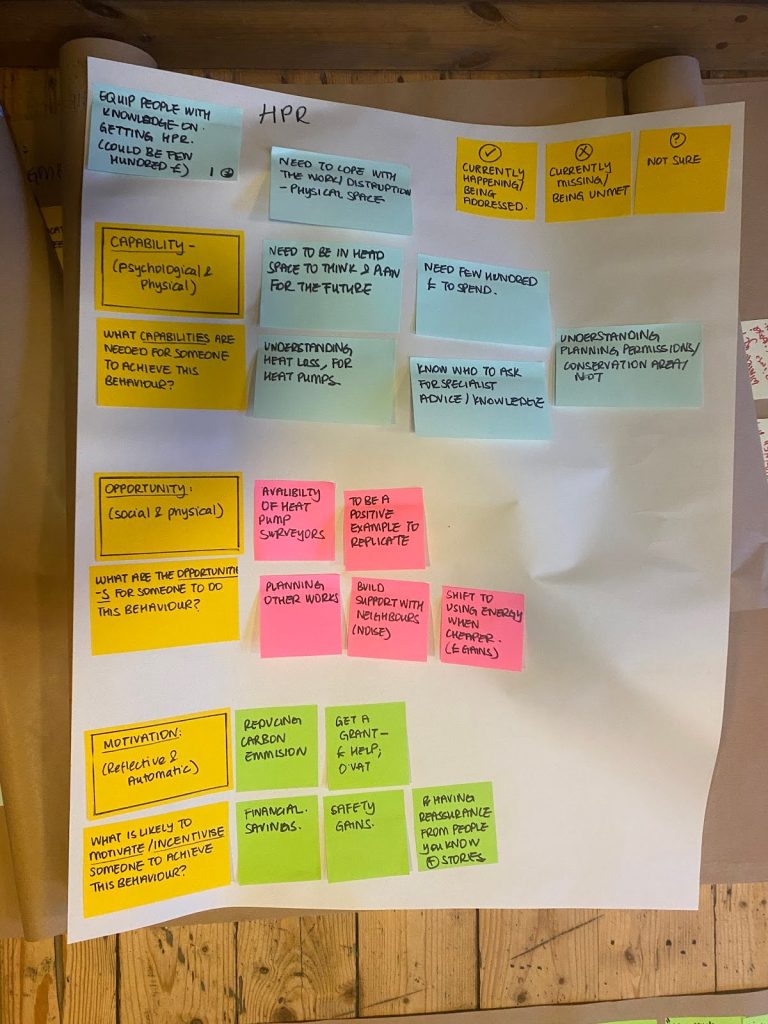
The final activity we did for each intervention was to take one behaviour and carry out a COM-B analysis on that behaviour. For example, for the behaviour ‘Householder instals a heat pump’ we identified that there were barriers to capability in terms of understanding of how heat pumps work, having time and space to make a plan, and having finances in place. There were barriers to opportunity in terms of heat pump surveyor availability, but enablers in terms of installing a heat pump alongside other works, and being able to shift to using energy when it’s cheaper. The enabling motivations included wanting to reduce carbon emissions, wanting to improve safety, and being reassured by others who have installed a heat pump through their stories.
Outcomes
At the end of the workshop, we had mapped out 4 interventions and had a better idea of the target behaviours for each of our programme’s thematic areas.
Our team became familiar with the processes of mapping out an intervention, identifying key behaviours, and carrying out a COM-B analysis. Chandni summed it up well when she said that these were all ‘tools’ that we could use to plan and evaluate our interventions with regards to Behaviour Change.
Personal reflection
I felt that this session made explicit a lot of the implicit understanding that our teams have about what behaviours they want to affect with their activities, and what interventions work well or need improvement. It was helpful to get into the nitty gritty of each intervention, and to have the external view of our facilitators who could ask ‘why?’.
Time was a challenge: we had ambitious aims for this workshop and it was always going to be hard to get through everything. Val and Chandni did a great job of keeping us on track and adapting the plan to things that came up on the day.
By the end of the session, I had a new conceptualisation of our three thematic areas. While before I had thought of each area as having a distinct audience, with distinct behaviours attached to it. Now, my understanding was that the three thematic areas intersected and built on one another. We could visualise this as a Venn diagram:
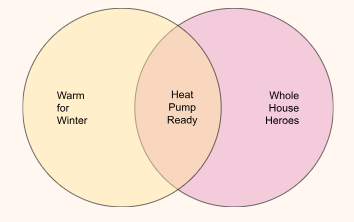
This shows how each of the thematic areas of our project intersect, with some people in the Warm for Winter and Whole House Heroes thematic areas also having an interest in heat pumps and thus taking on some Heat Pump Ready behaviours.
Another way of visualising this might be like so:
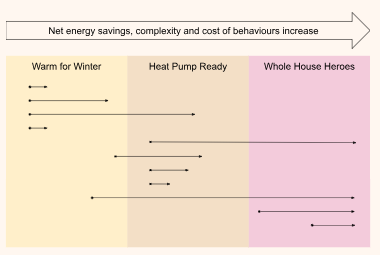
Here, each arrow represents a participant in the programme, with the circle being where they start and the arrow being where they progress throughout the project period. We can see here that some people will come into one thematic area and stay in that area throughout their time engaging with the programme. But others might start in one thematic area and progress to another. We can also see how some participants may engage with some activities and not others, meaning their participation is shorter.
Following on from this workshop, we organised a knowledge-sharing session with Ellie Kuitenen about her work applying Behaviour Change methodologies to retrofit in Manchester. More on that in the next post!