
A guest post by Sandy Rushton, People Powered Retrofit. Originally featured on Medium.
In this post I want to talk about how I’d conceptualised our approach to Behaviour Change at the start of this project, and how this changed once we’d started working with our partners at the service design agency, Snook.
Following some initial research into Behaviour Change approaches, I’d started to conceptualise how we might be able to develop our programme’s Behaviour Change methodology. This work built on thinking that Jonathan Atkinson (Carbon Coop) had done while scoping this project.
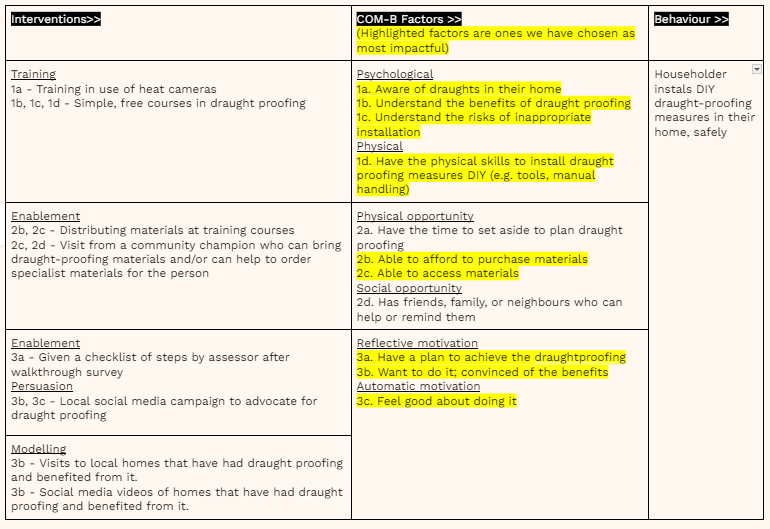
My assumption was that we’d take a “traditional” approach to COM-B analysis. We’d start by defining target behaviours for energy advice. Then we’d map out the barriers and enablers for each target behaviour, prioritise those based on impact, and design interventions that would address each behaviour. I attempted this myself (in a non-evidence based way!) just to test out how this approach could work in the project.
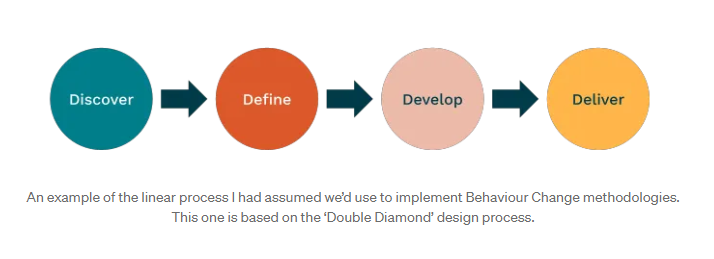
I attempted to work through this process myself (in a non-evidence based way!) just to test out how this approach could work in the project.
Identifying our project’s target behaviours
With the COM-B approach in mind, our team arranged a meeting focused on identifying the target behaviours for the Energise Manchester programme.
At this meeting, Marianne Heaslip (Technical Director, People Powered Retrofit) presented a list of behaviours she had identified for each of the project’s thematic areas: “Warm for Winter”, “Heat Pump Ready” and “Whole House Heroes”.
By the end of the session, I was hoping to have a list of 1-3 behaviours per thematic area, which would inform our COM-B analysis.
Marianne Heaslip delivered her presentation to me, Lorenza Casini and Jonathan Atkinson from Carbon Coop, and Chandni Patel and Val Mitchell from Snook. In her presentation, Marianne outlined a number of key behaviours and helped us to understand what types of action householders could take.
From Marianne’s presentation, my main takeaway was that the behaviours involved in retrofit are complex and interrelated. There could be few or many steps involved in carrying out energy efficiency works. There are also many different measures for householders to choose from; a given energy efficiency measure may be suitable or not suitable for a given householder and property.
Marianne’s presentation helped us to understand the sets of behaviours for each thematic area as processes, consisting of a series of choices that have to be made and actions that have to be taken. Behaviours relate to different topics: making a plan, monitoring energy use, adjusting energy usage, or installing new technologies.
Reframing our approach to Behaviour Change
Chandni and Val from Snook provided invaluable input to our Behaviour Change frameworks at this stage. They pointed out that Carbon Coop, Manchester Care & Repair and People Powered Retrofit already have a range of developed interventions that have been used to deliver energy advice. We aren’t starting from scratch on this project and a process of conducting research to inform COM-B analysis could curtail our capacity for delivering energy advice in our target areas during the first few months of the program.
As we already had a range of tried and tested interventions that could be rolled out or adapted for this project, Chandni and Val suggested it would be most useful to start by mapping out the interventions that were already in use. From there, we could tease out the behaviours that these interventions are targeting.
This approach could also help us to manage the complexity and number of behaviours that Marianne identified in her presentation; we could focus on behaviours that our project’s planned interventions are particularly well placed to address.
Personal reflection
When I’d initially learned about models of Behaviour Change, I had seen them as quite rigid, linear, and theoretical. The input from Snook during these early sessions helped me to reformulate my understanding of our Behaviour Change methodology and project approach, from a linear approach – with a research and intervention design phase followed by delivery of interventions – to one where the research, design, and implementation would be carried out in a cyclical and agile manner.
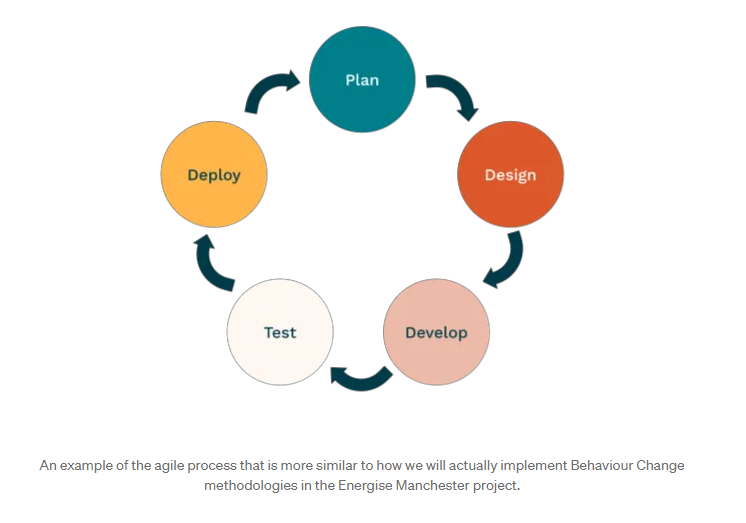
The understanding that behaviours can be explored during the delivery of interventions was useful for me to reformulate how the Behaviour Change methodologies can be applied to Energise Manchester. For other organisations who are already delivering energy advice and want to use Behaviour Change methodologies in their work, this type of approach may be better suited than an up–front design stage.
I also gained a better understanding of who the audience is for Behaviour Change. I had only been thinking about the audience as members of target communities living in our project areas. However, there are other actors whose behaviours are of interest for our project:
- Project partners’ staff who will be delivering interventions
- Volunteers
- Friends, family and neighbours of householders who are taking part in our programme
- Members of the retrofit supply chain (such as heat pump installers, handy people, contractors etc.)
By mapping interventions, we hope to be able to pull out the actors involved in each step of an intervention’s delivery and identify their behaviours, too.
I’ll continue to reflect on how our methodology shifts and develops throughout this project.