
A guest post by Sandy Rushton, People Powered Retrofit. Originally featured on Medium.
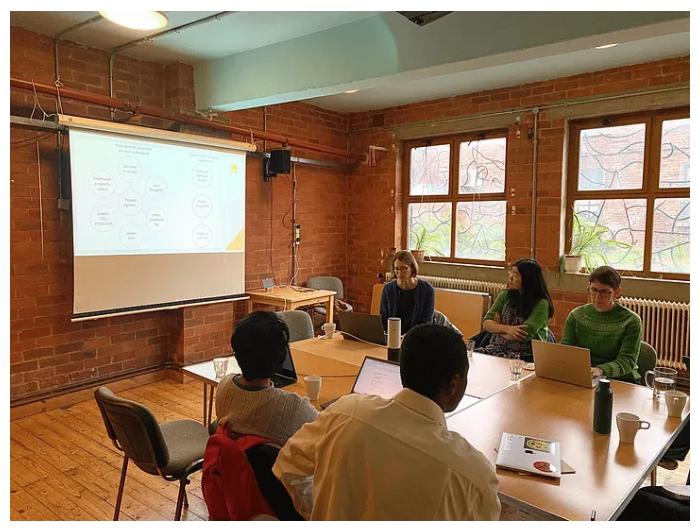
On November 2, 2023, the Energise Manchester team took part in a knowledge sharing session with Ellie Kuitunen. Ellie is an energy consultant who has worked at Manchester City Council, focusing on the adoption of large-scale retrofit. She recently completed an MSc in Behaviour Change to consider how psychology and understanding human behaviour can be applied to better engage key stakeholders and end users of major retrofit projects, at scale.
We learned about Ellie’s work on Behaviour Change and retrofit, in particular her essay “Designing an intervention to increase the impact of the Green Homes Grant scheme — An application of the Behaviour Change Wheel Framework”.
In this blog post, I’ll share some key takeaways from the session.
Behaviour Change theories
Ellie talked us through some widely used behaviour change theories, starting with the Behaviour Change Wheel and COM-B models. She pointed out that this model is quite straightforward to use, even for non-experts, but that the quality of the intervention design is dependent on the quality of the information you put into the model.
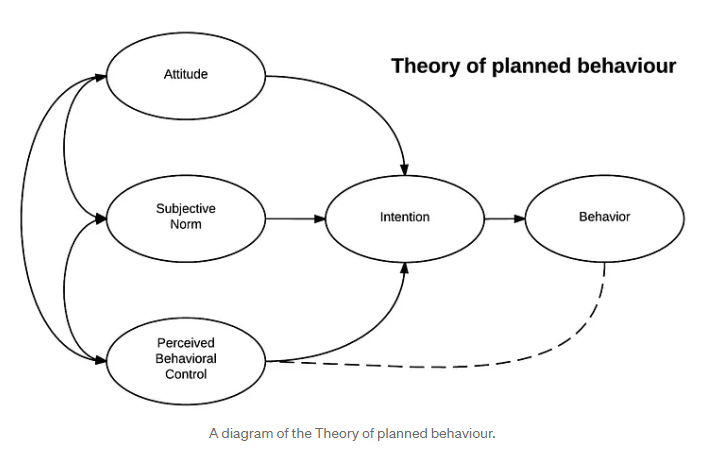
Ellie has used the Theory of Planned Behaviour, which has been quite widely used in energy. In this theory, a person’s behaviour is dependent on their intention to carry out that behaviour. Their intention is in turn influenced by their attitude towards the behaviour, their subjective norm (i.e. perceived social pressure to behave in a certain way; others’ attitudes towards that behaviour), and the perceived behavioural control (i.e. how difficult or easy they see the behaviour as being, due to external conditions).
Ellie’s hypothesis is that there are two key challenges for housing retrofit: funding/finance and resident buy-in. In her work she’s addressed both of these topics.
Her latest research focuses on the Net Zero Neighbourhoods Model.
What are Net Zero Neighbourhoods?
The model has been described by 3Ci, amongst others. It is a model for large-scale retrofit where households sign up in large numbers to access funding provided by others. The homeowners don’t pay up-front, but rather pay a ‘comfort charge’ on the home after the works have taken place. This charge is paid over a long period and is tied to the property. If large numbers of homeowners sign up, any profits generated could be re-invested into the neighbourhood e.g. more greenery, improving safety, waste reduction facilities, active travel improvements etc.
Research methods
Ellie’s MSc research asked whether it is possible to use Behaviour Change theories to identify a neighbourhood/community in Manchester where the Net Zero Neighbourhood concept is most likely to succeed.
She found from a review of past research that likelihood to engage in environmental behaviours are impacted by many factors, but that past environmental behaviours, ‘connectedness’ with nature, and community identity had all been identified as key factors.
To find out more, Ellie distributed an online survey to Greater Manchester residents. She used the Theory of Planned Behaviour to design the survey. The surveying took place from March-May 2023, and included 81 participants across a range of ages, genders, household income levels, IMD deciles, and from all boroughs of Greater Manchester. However, the participants were largely white and university educated which was likely due to distribution of the online survey through Ellie’s existing networks via LinkedIn.
Attitudes, subjective norms and perceived behaviour control
The survey included a number of questions to understand people’s attitudes towards retrofit. Ellie found that most people understand the benefits of retrofit (keeping them warmer in winter, making the home less draughty, increasing comfort, lowering bills etc.), but that people did not generally agree that retrofitting their home would help to reduce damp and mould or keep their homes cooler in summer.
In terms of perceived behavioural control, access to finance and advice services were identified by respondents as the major factors that would positively impact their ability to retrofit their homes, and also reported that they did not currently have access to these finances or services.
To understand the subjective norms, a survey question was included asking ‘Would my family, friends, and close community approve?’. For retrofit, 88% of respondents agreed that their family, friends, and close community would approve. This was 51% for signing the long-term contract under a Net Zero Neighbourhood arrangement. Ellie also asked whether respondents’ family, friends, and close community would consider doing the same. 86% agreed that most people like them would consider improving the energy efficiency of their home, and 42% agreed that most people like them would consider signing up to a long-term contract.
When asked about their neighbours, 21% agreed that they want to achieve similar levels of energy efficiency as my neighbours and 15% agreed that their neighbours would consider signing up to a long-term contract. We had an interesting discussion about the interpretation of these results in our session, with members of the Energise Manchester team remarking on how this possibly reflects how early adopters of retrofit might see themselves as the ‘odd ones out’ in their neighbourhood. Depending on the person, the location (e.g. city/rural), and the demographics of the area, people might not feel close to their neighbours, or think that they know much about their neighbours. But the opposite can also be true, where in some neighbourhoods we’ve observed clear patterns of behaviour where a single household making a change (e.g. installing double glazing) influences their neighbours to do the same.
Indicators for ‘environmental behaviours’ and retrofit
Ellie looked at how much past environmental behaviours, ‘connectedness’ with nature, and community identity correlated with respondents’ willingness to sign up to a Net Zero Neighbourhood style retrofit contract. She found no correlation between willingness to sign up and past environmental behaviours, and only a weak correlation between willingness and nature connectedness or community identity.
Ellie concluded that domestic retrofit and signing up to Net Zero Neighbourhood services are not necessarily ‘environmental behaviours’. So, previous research that outlines factors that positively impact the likelihood of engaging in environmental behaviours — like recycling or donating to environmental charities — cannot necessarily be applied in the context of domestic retrofit.
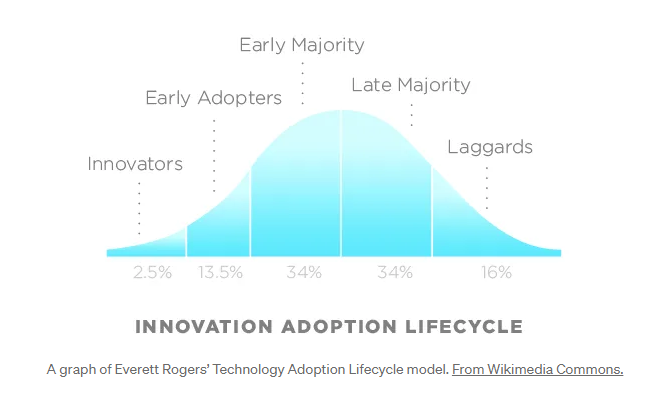
We discussed this as a group, and agreed with Ellie’s conclusion that retrofit is not a purely environmental behaviour and posited that perhaps it can be considered a financial behaviour, more similar to choosing to take out a mortgage than to recycling waste. We talked about how this might be different at different points on the innovation curve, as innovators and early adopters may be more influenced by environmental motivations than those in the general population.
We also discussed whether retrofit is thought of similarly to other home renovations (e.g. a new kitchen) and how the attitudes of society, peers and housing professionals, like estate agents, could influence the value people place on retrofit.
A likely neighbourhood?
To answer the question of whether it’s possible to identify neighbourhoods where a trial of the Net Zero Neighbourhoods concept would most likely succeed, Ellie found the evidence weakly points towards communities with a strong sense of belonging, nature connected neighbourhoods, and those with younger populations.
We had a discussion about this and shared insights from the Energise Manchester partners’ experience. Partners shared their experiences from other retrofit schemes, where they had different findings in terms of likelihood from older rather than younger homeowners. The idea of how settled a person is in their home also came up, with people who planned to stay in the home long-term more likely to take up retrofit programmes.
Final thoughts
Ellie had lots of other interesting insights from her research, which I haven’t been able to include here for the sake of brevity! We thank her for sharing her work with us, and encourage others to seek it out.
For me, the reflection on how Behaviour Change models can be used to carry out user research about new retrofit services was interesting and relevant for our project. We’ll be using Behaviour Change theories to carry out research and service design in Energise Manchester, so it was helpful to hear how this has been done in Ellie’s work.