
In this blog, our Research and Evaluation lead Helen Grimshaw, reflects on her involvement in Retrofit Revisit, and what the findings mean for our work at Carbon Co-op.
The opportunity to evaluate a retrofit project doesn’t come along often. You might find that surprising given the innovative nature of the work we’re involved with, but it often boils down to a lack of budget and access. But knowing what works well and what could be better, is hugely important if we are to deliver more, and better quality retrofit.
So being invited to act as an Evaluator on a large scale evaluation project, revisiting a series of deep retrofits completed around 10 years ago, we jumped at the chance! Now the extensive report titled ‘Retrofit Revisit’, led by industry experts Julie Godefroy and Marion Baeli, has been published and is free to access via the CIBSE website.
Over the course of this blog I will:
- summarise the study aims and scope
- summarise the case study I was allocated
- reflect on the nuance around occupant satisfaction, system complexity, the skills needed by building performance evaluators, and the tools we used as evaluators
- round up with some of the overarching findings and their relevance to the approaches we take at Carbon Co-op.
I’m very grateful to the two lead authors of the report and the driving force behind the project.
Julie Godefroy is the net zero lead at CIBSE – the Chartered Institute for Building Service Engineers, and has an independent consultancy – she’s also a collaborator of Carbon Co-op and People Powered Retrofit.
Marion Baeli is an Architect and Principal for Sustainability Transition at 10 Design. Marion authored ‘Residential Retrofit: 20 case studies’ which was the basis for this ambitious revisit project funded by Innovate UK and Historic England.
Also thanks to Marianne Heaslip at People Powered Retrofit, who taught me the ropes in building performance and post-occupancy evaluation over several years, and who acted in an advisory capacity on this study.
What did Retrofit Revisit set out to do?
Retrofit Revisit was a building performance evaluation (BPE) study that revisited 10 homes, around 10 years on, to see how the retrofits were performing. Importantly, the 10 homes had all been subject to BPE studies shortly after they were completed, so we had a good amount of data to compare. We were particularly interested in the performance of the retrofits:
- What stood the test of time?
- Whether there were new lessons to be learned about how to carry out retrofit projects?
We explored topics like the energy demand of the homes, moisture, insulation options (moisture and combustibility), degradation of original solutions (such as airtightness).
But, we were also interested in the techniques used to do evaluation:
- What can be learned in a relatively short monitoring period, in a non-intrusive way (i.e. without cutting away at walls, roofs and floors)?
- Where are more specific or detailed methods useful? And how might newly emerging techniques help?
All 10 projects were subject to what was christened ‘Core Scope’ BPE, consisting of site visits, an occupant survey, an audit of energy use and one month of ‘winter’ monitoring which was input into Build Test Solution’s SmartHTC software. Half of the projects were also subject to ‘Detailed scope’ BPE, which included independent witnessing of airtightness testing, more technical methods to assess thermal performance (such as in-situ U-value measurements, thermal imaging etc), and moisture (such as physical tests to the fabric, and fungal spore counts, hygrothermal analysis and in-situ monitoring).
Princedale Road
As an Evaluator I was given the case study of Princedale Road in London. Having not been part of the original design or evaluation teams, I was approaching the project fresh. Princedale Road was quite the trailblazing project 10 years ago, being the first PassivHaus Certified retrofit in the UK. It still displays the plaque proudly by the front door, and the occupant still spots keen students taking photos from the street.
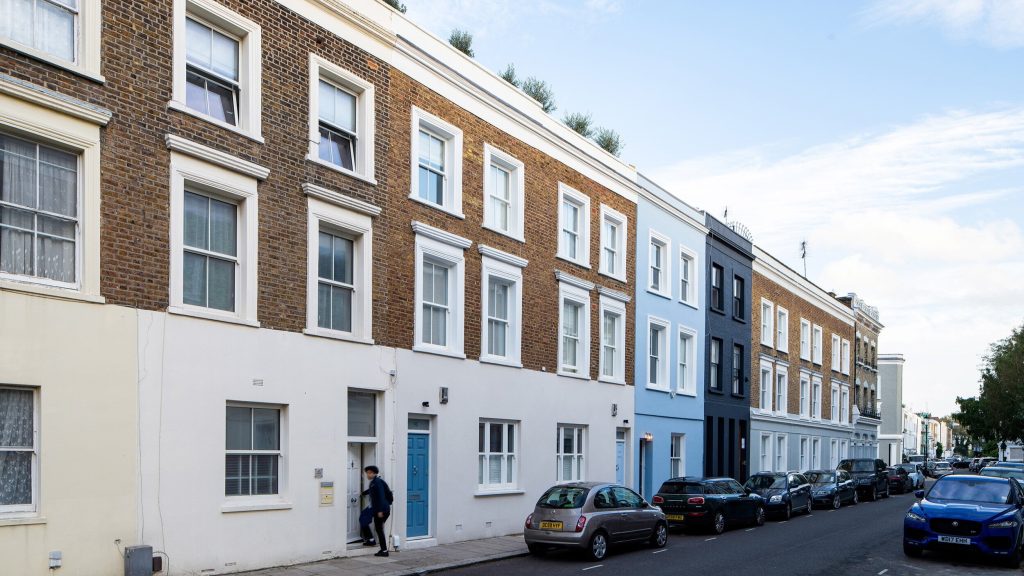
Photo credit: Studio PDP
Princedale Road is owned by a housing association and is a 1869 built mid-terrace located in Holland Park, London. It has three storeys plus a basement. As part of the retrofit the house was completely gutted, with new floor joists re-hung on steel beams resting in insulated pockets within party walls. This allows insulation boards to pass uninterrupted between the new floor structure and the existing facade. It also had a very innovative heating and ventilation system for the time – a Genvex Combi system that houses both a hot water cylinder and Mechanical Ventilation and Heat Recovery (MVHR), with the supply air heated via an integrated mini air-source heat pump. Plus, the unit is integrated with roof mounted solar thermal panels. A retrofit with all the bells and whistles! We were all very curious as to whether this set-up had proved reliable and easy to use.
You can find all the technical findings by reading the case study in more detail. In the following sections I offer some personal reflections.
Happy tenants
It was telling that the tenants to first move in after the retrofit are still there now, and the occupancy survey findings expressed high to very high rates of satisfaction, especially for winter comfort and noise. The high rates of satisfaction were interesting when compared with energy usage, which appears to have crept up over time, although is still very low compared to a typical home. This reinforced for me the importance of:
- The home providing a consistently comfortable environment, which appeared to be the overriding priority and takeaway for the tenant.
- Needing to join the dots and view performance as a whole. If we had purely looked at technical performance, the narrative for this case study could have been framed as ‘degradation in airtightness performance’ and ‘increase in energy use;’ yet we know this would not have been the whole picture and neglect the social context of a growing family and changing habits. Indeed, it would have been misleading of overall levels of performance.
The other interesting thing about occupant satisfaction across the case studies was the variation in internal temperatures. The winter monitoring at Princedale showed average temperatures of 17 to 18c across the home. This would be considered on the cooler side compared with what standard energy models assume (21c in living areas), and yet the tenants were very happy and found it comfortable. This temperature was lower than that reported in the original BPE study with different preferences, life stages and their associated activities (e.g. more cooking) appearing to be factors in this.
Living in such a well insulated home seems to make a difference, with the fabric buffering it from large swings in temperature, and the close attention to thermal bridging and airtightness practically eliminating cold surfaces and draughts. We know from other case studies that some occupants prefer it much warmer, and even then temperatures achieved don’t necessarily align with satisfaction. Humans are complicated!
System complexity
The innovative set-up at Princedale for heating, hot water and ventilation both confirmed some of my existing beliefs around system complexity, and challenged them!
The complex set-up had created challenges, and coincidentally some of these came to light just as we were starting the research when the Genvex unit failed fully for the first time. This proved to be a real point for discussion in the write-up, but it was also a little frustrating because it meant that we were conducting our monitoring at a time when the ventilation system in particular wasn’t working as it normally would.
From experience, we find that system complexity can create issues with:
- The ‘organisational memory’ and asset data relating to projects, particularly within a housing association or landlord setting – knowing what systems are installed in a home, how they are maintained, and what skills are needed to fix them can be lacking.
- User familiarity – in the case of Princedale the tenants were very complimentary about the home user guides and assistance they received at the time (not the norm, but due to some very dedicated professionals in the project team). However, we couldn’t locate the home user guides, and the settings on the very complex control panel had been changed over the years. It’s possible that the ventilation system wasn’t quite working as well as it could, and would have benefited from recommissioning as well as a refresher for the occupants and maintenance teams.
- Monitoring – for all the ‘bells and whistles’ in the system, we were lacking monitoring data. For example, there was no sub-metering that allowed us to ascertain how much heat the solar thermal system contributed. And some legacy monitoring equipment complicated investigations – much of this had been left in-situ but was no longer collecting data, and this took a while to deduce as none of it was documented in the original BPE exercise (simple marked up drawings would have been very useful). The exception to this was an electricity meter that was still ticking over, and which provided us with a very useful cumulative reading of kWh over many years. However, working out which meter was operational for billing purposes was a challenge.
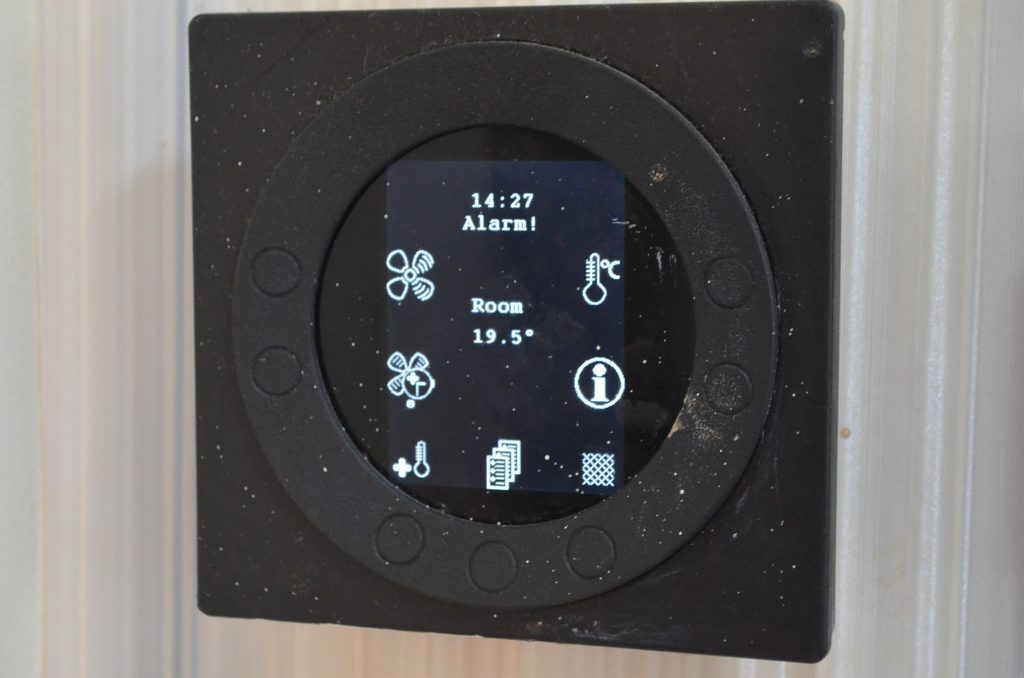
Complex control systems for users and maintenance teams.
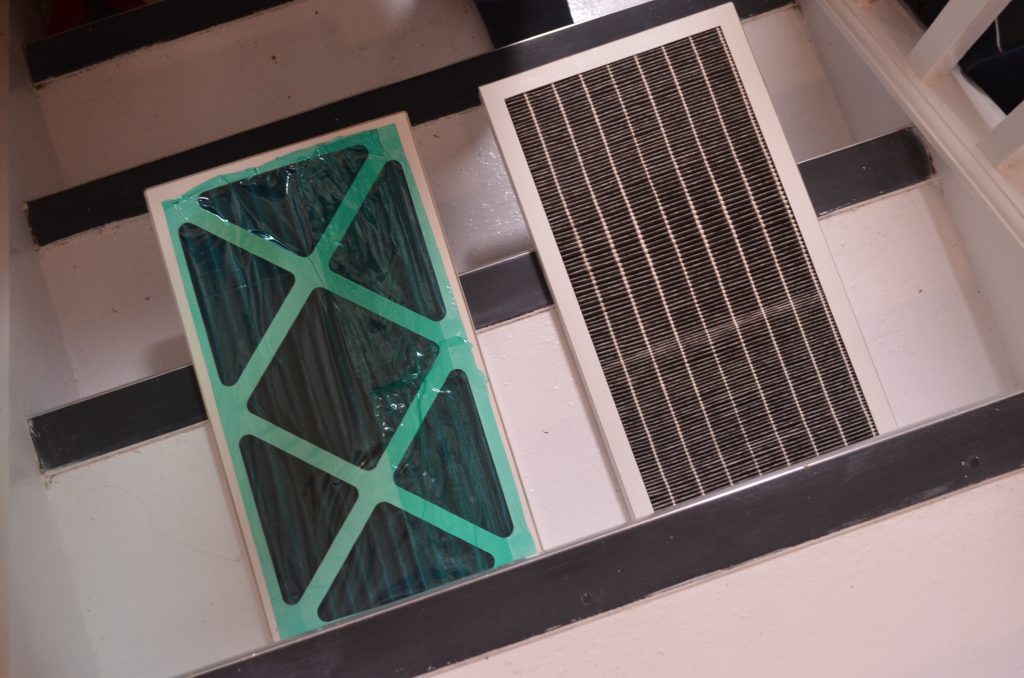
Clogged filters on the MVHR system.
The complex systems challenged our assumptions in other ways. It was remarkable that in 12 years the system had only just failed. This surprised the original design team as much as me. The solar thermal system in particular had required very little maintenance and was continuing to work well.
Evaluators need a broad skill set
I was perhaps optimistic that having only one fuel to look at (electricity) would make the energy analysis more straightforward. This wasn’t the case! Deducing which was the working meter took some time, but even then I uncovered some issues with billing and the tenant’s relationship with the energy supplier. This meant (despite a smart meter), we weren’t able to access the historical data, nor the half hourly data logged during our winter monitoring window. This was compounded by the meter cupboard being located 2 metres above floor height, right by the front door, which made it very difficult for the tenant to take a manual reading for us every week. Trying to resolve issues like this takes time, and being able to signpost to support is important. Some practical pointers on navigating quirky situations like this (which I’m convinced are actually the norm!) would be very useful to have as part of a BPE Evaluator’s toolkit.
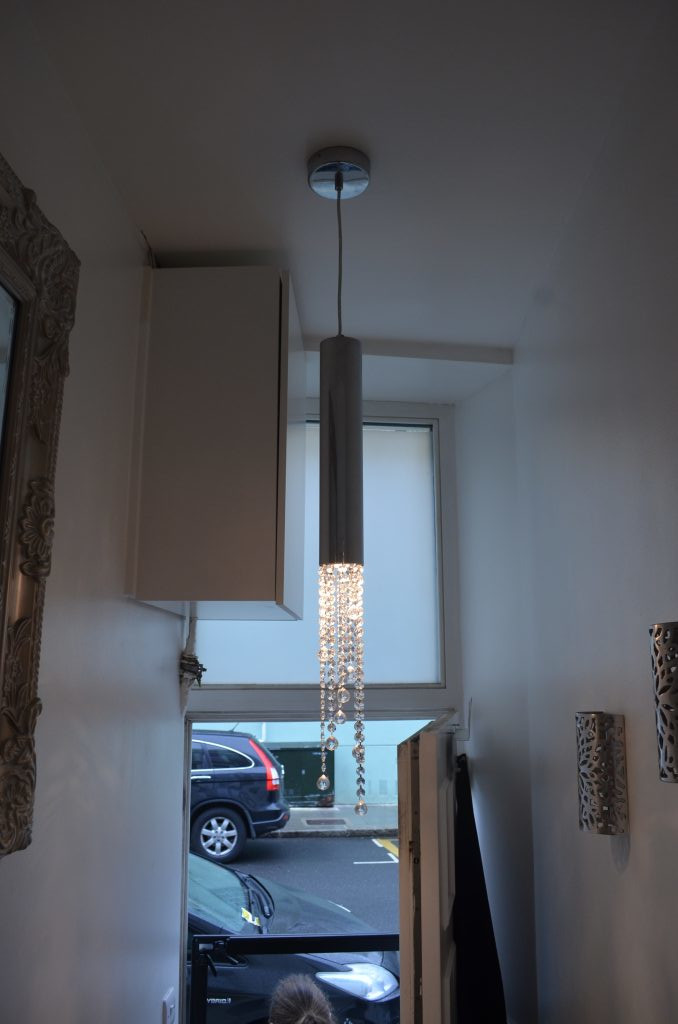
A meter cupboard that was very difficult to access!
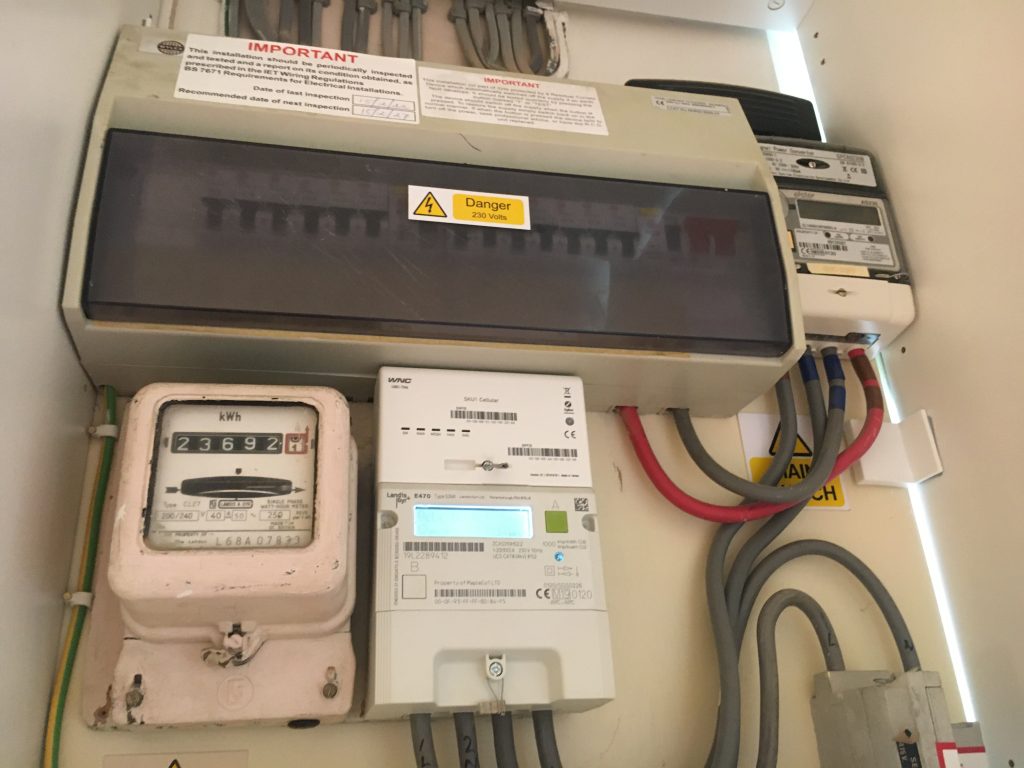
Deciphering old meters, new meters and old monitoring equipment took some investigative work.
Testing out new tools
This study was a great opportunity to test monitoring and evaluation solutions like Build Test Solution’s (BTS) Smart HTC. This involved installing temperature and humidity room sensors, which when combined with meter readings and information about the home can generate an in-use ‘Heat Transfer Coefficient’ (HTC). This is a good measure for how thermally efficient a home is. We had great support from Luke and Richard at BTS, who briefed us on installing the sensors and using the software.
I quickly found that trying to model a home that had been designed using the Passivhaus software PHPP wasn’t a neat fit as the conventions differ from SAP. But with some workarounds we were able to come up with a way of creating a comparable design HTC value from the PHPP data. Princedale also has a very bespoke design, and I was unsure whether the difference between the design and actual HTC values would be a fair reflection.
The airtightness testing also generated some interesting learning about measurement conventions as we ended up with slightly different volumes to the testing done at completion. Again, better documentation would be really helpful for Evaluators and technicians revisiting things many years later!
The templates and scope for BPE activities provided by Julie and Marion were very helpful and useful in practice, as well as providing important consistency across the case studies.
Overall findings
The overall findings are really important to convey, and this is such an important piece of work for organisations across this sector. I’d highly recommend that you read the executive summary for the summarised findings, but my key takeaways are:
- Retrofit has delivered long-term benefits, with energy use still significantly lower than in the average stock.
- Fabric efficiency improvements have been shown to be very effective in the long run, with heat demand remaining very low compared to the national average.
- Only a small number of instances have been found of material deterioration, and in most cases these have been very localised issues. In many cases these are linked to maintenance. Maintenance is key, and a big reason why at Carbon Co-op we are advocating for consideration of building condition and repairs in projects such as Energise (our energy advice demonstrator).
- Mechanical ventilation with heat recovery (MVHR) has shown to be reliable in these case studies, and seems to be a big factor in high levels of occupant comfort.
- Ease of controls remains an issue, even in homes where residents report good comfort and relatively simple systems.
- We need to be actively thinking about designing for high summer temperatures, something that was rarely on the radar 10 years ago.
- We need to get much better at metering and monitoring if we are to fully understand the performance of our homes as we decarbonise them. This is something we feel well placed to contribute to at Carbon Co-op.
There are often cases of bad press related to retrofit (some rightfully so), but this study shows that retrofit with considered design and attention to detail (from briefing stage right through to handover and beyond) can deliver very good outcomes. For me this has reinforced that the approaches we take are the right ones – of care, attention to detail and centering of users. Let’s use this valuable report as a catalyst to do more, high quality retrofit.
