
We all want warmer, comfier, greener homes with lower bills but sometimes it seems the options are either to stump up a load of cash for an expensive consultant and builder or go with a retrofit council scheme where you get little choice on how it turns out – but might there be a third way? One where we take control and figure out a way to improve our houses together?
In this article we introduce our collective retrofit project in Levenshulme, South Manchester, where building work has started on upgrading five terraced homes in neighbouring streets.
The retrofit challenge
Back in 2015 we delivered a series of whole house retrofits all around Greater Manchester with a group of our members. We took householders through the process as a group, sitting in the middle and contracting a builder to do the work. At this stage we were still understanding what was possible with different house types, and whether we could reduce heating use significantly by applying combinations of external wall insulation, new windows, better roof insulation etc. It was a huge learning curve for us, but demonstrated that ambitious retrofit was possible and could deliver very positive outcomes.
Taking what we had learnt, we had ambitions to do community-led retrofit again, but focused on a single area of Manchester. We believe that good quality retrofit, tackled street by street within a neighbourhood, can unlock more than just more efficient, affordable and comfortable homes. That it can generate bill savings, unlock more innovative ways of financing the work and invest in local skills.
An area-based approach retrofit
The approach we’re taking is focused on:
- Setting homes on a path to a whole house retrofit, even if we don’t do everything now. This means we’ve carefully considered a package that is feasible with the money available, should deliver noticeable improvements, and not compromise other works that may come in future.
- Centering residents in design and delivery, carefully considering their needs and wants, being open and transparent and ensuring they are central to what gets delivered and how this is done.
- Having a high degree of control around design, specification and installation. Quality is important to all of our stakeholders – as a community intermediary we can champion and protect this focus on quality in our role.
Early days
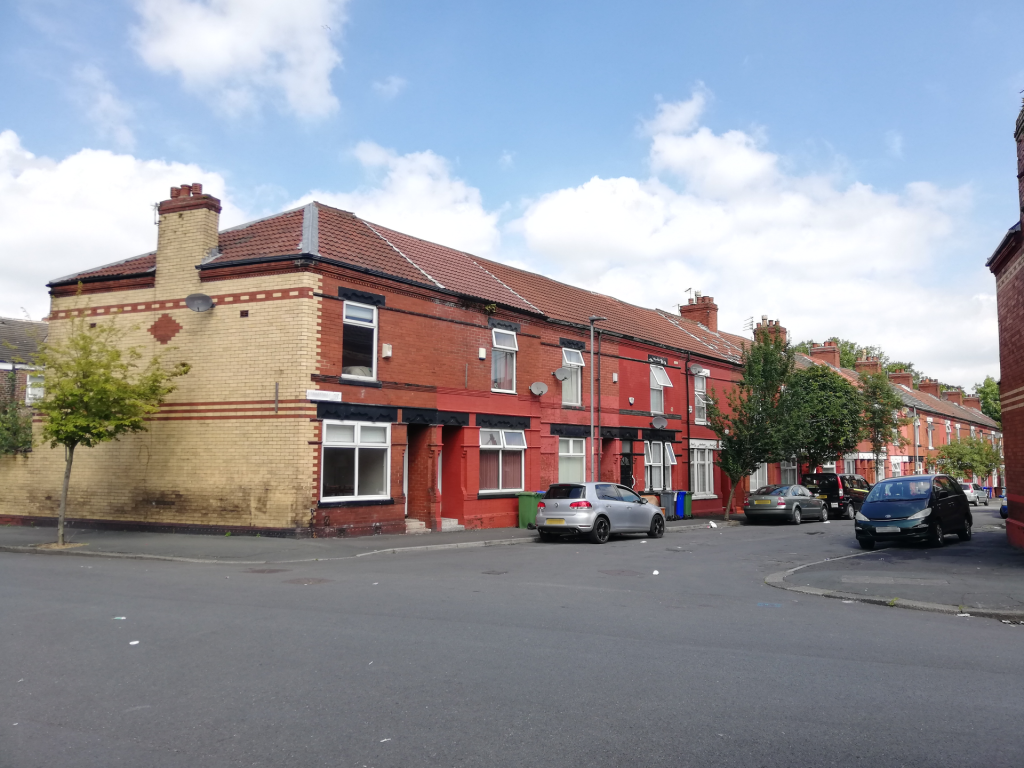
Alongside lots of conversations locally, we commissioned designers and long time collaborators, URBED, to do a study looking at different house types in the area. Even a terrace that looks the same from the street can have lots of different house types, because we adapt and expand our homes over the years. This helped us develop a more robust brief and start thinking about works that would suit the homes. We ended up with the following:
- Mid and end terraces across three neighbouring streets
- All with two storey outriggers at the back
- Walls built with a very slim cavity
- One home with a single storey extension at the back
- Gas central heating and radiators
- Limited or no planned ventilation systems.
Alongside this, we ran engagement activities, holding local drop-in events and posting letters through doors. We engaged broadly at this point, and were open to including different tenures (e.g. owner occupiers, private rent and social rent). However, the first phase has ended up with owner occupiers only. We are keen to explore barriers for private landlords as part of evaluation work.
The technical bit!
Once we had a group of committed households they received a ‘whole house assessment’ and retrofit plan, completed by our sister co-operative, People Powered Retrofit, which consisted of:
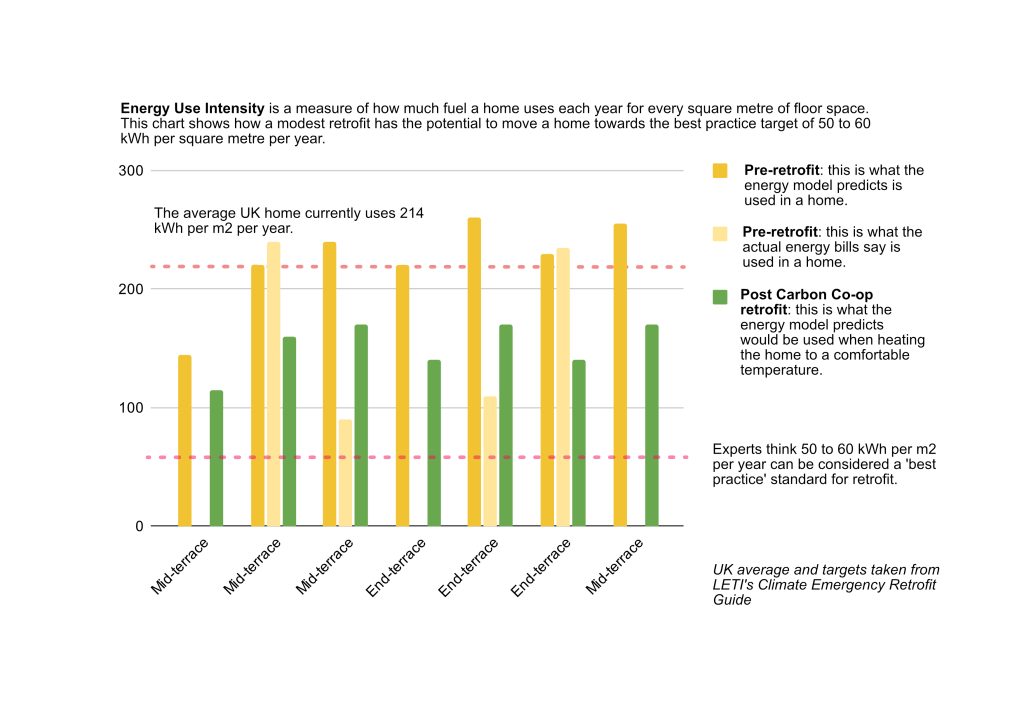
- an energy ‘model’ of the home – more detailed than an Energy Performance Certificate (EPC) and allows us to assess the impact of different works like wall insulation on heat loss.
- an occupancy survey – this allows us to understand how residents currently use their homes, the temperature they typically heat their home to and their current levels of ‘satisfaction’. We also collect data on their current energy use from bills so that we have a good baseline to compare against (not just a theoretical one!).
- Observations about the home’s condition – this is a good starting point for understanding what other works and repairs might need to be done first or alongside insulation.
By working to this whole house retrofit plan and taking a ‘fabric first’ approach (trying to reduce the amount of energy a home needs to use before thinking about things like solar panels), we created a standard package, with small tweaks to fit each home and their priorities. This includes:
- loft and roof insulation
- replacement doors
- high performance double glazing
- draught proofing
- improved extract ventilation
- external wall insulation to the rear and side
- Improved heating controls
- cap and fill chimneys or chimney balloons.
The fun bit, detailed designs!
Once the works were firmed up, we worked with our architect (Progress in Practice) to create detailed designs and submit the scheme for planning permission to the council. Seeking to centre the householders at all stages we held design workshops and meetings for residents to:
- Hear more about why we were proposing these works, and which issues we would be paying close attention to (including minimising all the tiny, unseen areas where heat leaks out)
- Visit another already retrofitted home with similar works so they could see for themselves, and hear from the resident about the level of disruption etc
- discuss the practicalities, like whether garden features like decking, fences and walls need adjusting for wall insulation, storage needs in lofts and accommodating cat flaps!
- Discuss render and window colours.
Placing residents at the heart of the process allows early discussion of things which sometimes seem small in the big picture, but can make a big difference. Selecting an architect who understands what is important to us and our residents makes a big difference here. As a result we were very relieved to sail through Planning!
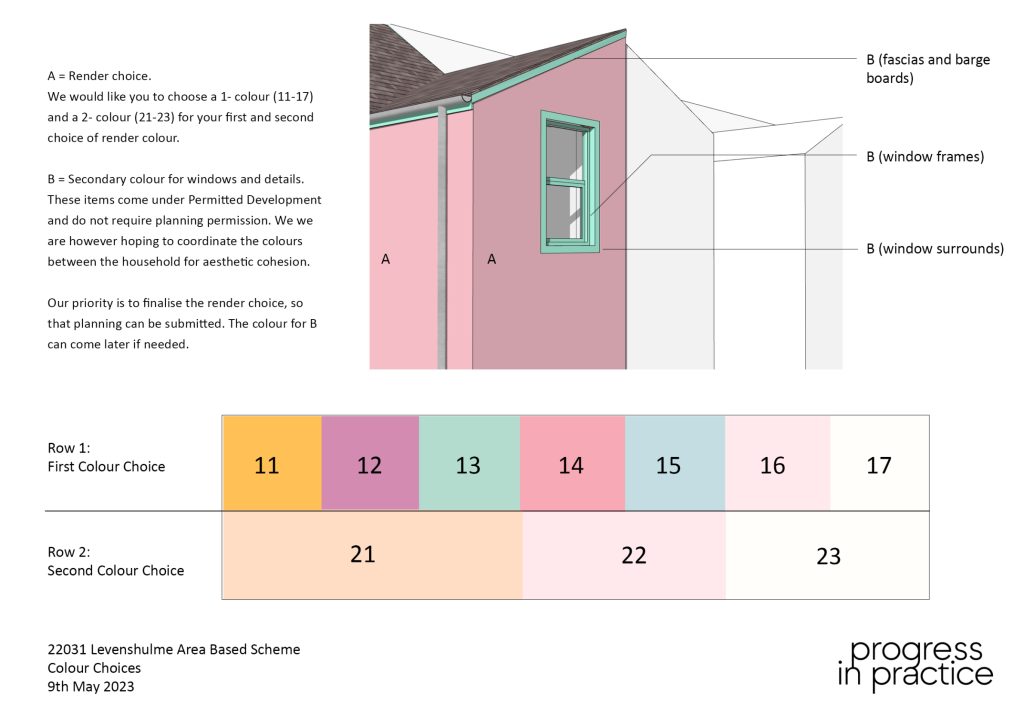
An example of the colour choices discussed with residents.
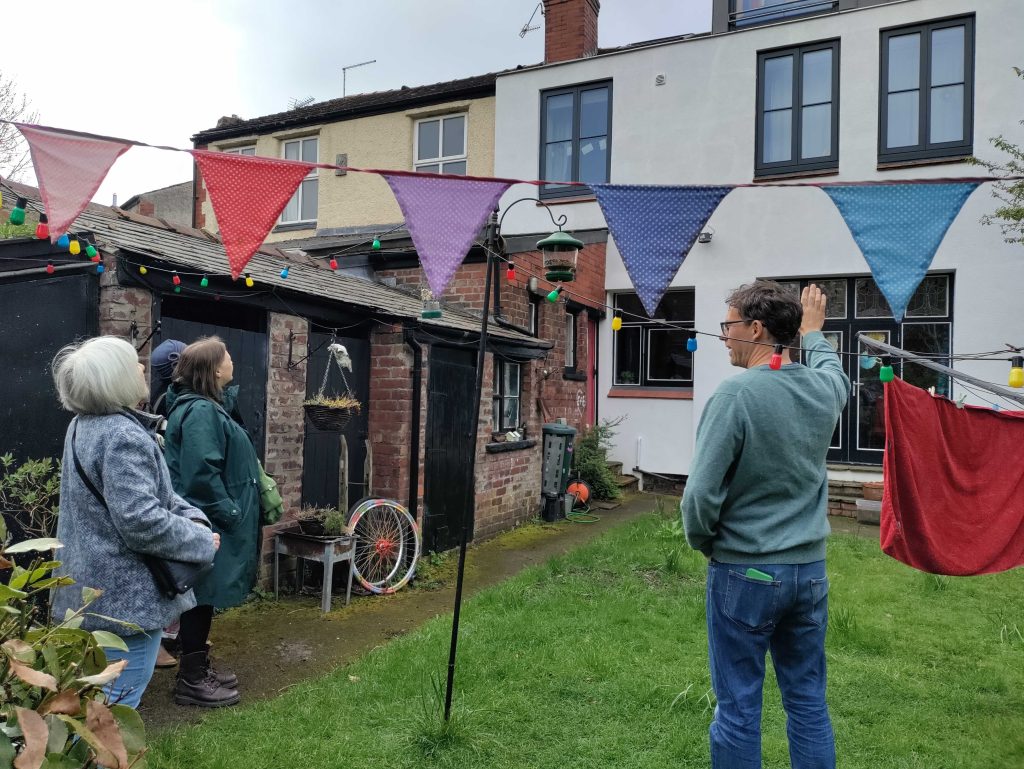
A visit to one of the homes we retrofitted under our Community Green Deal programme.
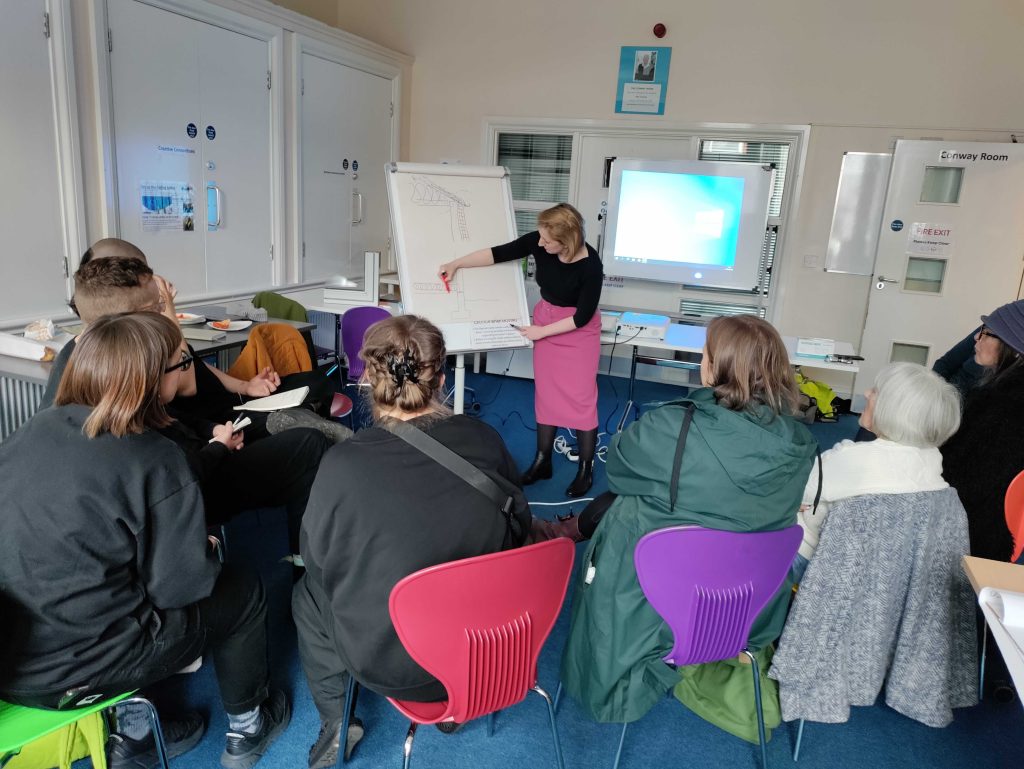
A design session with our Architect, understanding why details are important!
Getting builders on board
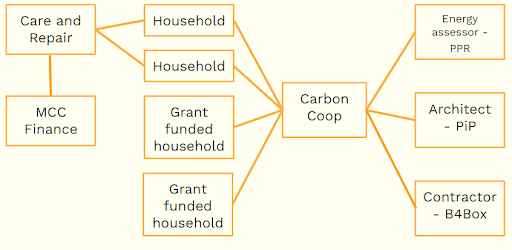
Energy efficiency schemes often use large builders working on a national scale and with big chains of subcontractors. In our experience, these are often headquartered many miles away and the heavy reliance on subcontracting can lead to greater levels of distrust. For delivery in Levenshulme we’re working with B4Box, an Ashden award winning builder and training provider whose work is framed by tackling poverty, addressing climate change, promoting social justice and addressing inequality.
Our ambition with B4Box is that this project will be the start of an ongoing partnership where we work together to build the supply chain locally, investing in people with the skills to deliver high quality retrofit. We’ve also received support from the MCS Foundation around skills and training.
Show me the money
For the Levenshulme project, building works are funded through a mixture of grant money and loans.
Manchester City Council are offering 0% interest free ‘group works’ loans of up to £35,000 per home, which only need to be paid back once householders are selling their home. This type of finance has been generally less daunting for householders as there are no upfront costs. We think there’s huge potential in this approach!
The grant pot was funded by the financial re-payments from Carbon Co-op’s 2015 Community Green Deal project and the eligibility for this was set by us, with criteria similar to that used by the local authority in allocating energy supplier funding.
However, individual circumstances and the grant money not being available for everyone means the incentives for householders to invest in the project vary. Different ‘financial personas’ mean that the motivations also vary, e.g. for young families, those older or if someone thinks they might move house in the near future. In this way, an intermediary like Carbon Co-op plays an important role in staying engaged with householders throughout to understand their position.
By combining homes in one project, the process can be more cost-effective because we can purchase design services, surveys, materials and labour ‘in bulk.’ As well as the architect, we’ve needed to commission supporting surveys to progress detailed designs. This includes things like:
- Airtightness tests (which measures how ‘leaky’ the home is, and helps pinpoint where these are)
- Measured surveys (important for accurate costings and material orders)
- Asbestos surveys
- Condition/structural surveys
- Electrical surveys.
These kinds of surveys and costs are not often talked about (and often don’t get people excited!) but it is important not to neglect if we really want to deliver quality.
What works and what we could do better
We’re really keen to maximise the learning from this project, for ourselves in delivering further Area Based Schemes, and for the wider sectors. To better understand the impact of the works we have:
- Fitted monitoring equipment such as temperature, humidity and air quality sensors, providing residents with a dashboard so they can log in and view the data too.
- Commissioned an external evaluation to get valuable feedback from residents, our delivery team, the builder and partners like the council, and we plan to publish outputs from these as the works progress on site.
The scheme is supported by the EBENTO Horizon 2020 project which is providing resource for data collection and analysis relating to the measured performance of the homes and the role of the intermediary in providing community based retrofit.
And so it begins…
Covid significantly impacted the development of this project and it’s been several years in development but signing contracts and getting loan paperwork approved have been huge milestones, reflecting a huge amount of work by our team. We’re now very excited to see the building work start, and for our residents this is long anticipated. With works expected to be completed in early winter, our residents’ homes will hopefully be much cosier and more energy resilient. And we hope to show what’s possible when you take a community led approach to retrofit.