
In Autumn 2014, we put together our application for the Ashden Award 2015, something that required us to summarise our work to date. You may already know a lot of this, but if you don’t, then read on…
How it came about….
The Society for the Reduction of Carbon, known as Carbon Co-op, is a pioneering community benefit society, assisting householders to work together to achieve large scale reductions in home energy usage through the installation of energy efficiency measures and small scale renewables – whole house retrofit. Householders join the society as members and pay an annual subscription to support the work of the co-op.
Making large scale reductions in household energy usage is a pressing concern, in terms of meeting carbon emissions reductions, reducing fuel poverty and addressing health issues.
Based in Manchester, Carbon Co-op started in 2008 as a project-based collaboration between co-operative consultant Jonathan Atkinson and urban design and sustainability practice URBED. Jonathan Atkinson is a project manager, who has been involved in Climate Change campaigning via Rising Tide etc, as well as Fuelling Manchester, Community Energy England, Greater Manchester Community Energy Strategy.
Carbon Co-op was incorporated as a community benefit society in August 2011 but has maintained a close working relationship with URBED, specialising in delivery of technical services and retrofit expertise.
URBED's research work has included a series of reports for SHAP, ‘Moving Beyond Decent Homes’ and ‘Community Green Deal’, which developed the feasibility and policy framework for a community-owned and run retrofit intermediary such as Carbon Co-op.
Carbon Co-op are currently alone in delivering a community-owned and controlled approach to deep retrofit, delivering highly ambitious, whole house improvements, building a replicable approach that can be copied elsewhere in the country.
Until now, Whole House/Deep Retrofit has been limited to individual enthusiasts in the SuperHomes network and similar organisations or housing association show homes.
In the Community Energy sector, organisations aspire to carry out demand reduction but technical challenges mean that groups focus on renewables, awareness raising and simple improvements such as changing lightbulbs. Groups have also been known to act as sales people for mainstream providers.
Our work is unique in the Community Energy world as well as the deep retrofit design and construction sector.
Householders are motivated by a combination of energy bill reductions, environmental, comfort and health benefits.
Retrofit has yet to achieve large scale due to a lack of trust from householders in Green Deal and providers, inaccurate assessment methods, high unit costs and poor supply chain development.
In the Community Green Deal programme, as of Autumn 2014, eight homes have been retrofitted and one home is partially complete with additional tranches of work required to reach the proposed 80% reduction targets.
The cost of the works ranges between £33,000 and £55,000 per property, with a total project cost of £375,000 and an average price per property of £41,500.
Community Champions
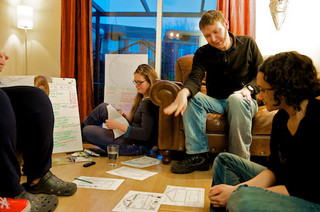
Since 2008, Carbon Co-op has been work on a street-by-street basis in areas such as Manchester, Stockport and Salford, providing the Community Champions programme, working with innovators to host participatory workshops for their neighbours.
The Carbon Co-op Community Champion workshops work at myth-busting, providing basic information and advice in order to reach more people through peer communication methods. Workshops have combined innovative engagement with high quality technical expertise.
The Community Champions programme identified lack of home energy information as one of the barriers to retrofit, alongside lack of appropriate finance and a lack of trusted suppliers for energy efficiency improvements.
Whole House Assessment Method
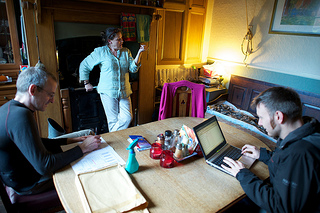
Carbon Co-op were able to begin to address the lack of home energy information when in 2012 DECC LEAF funding enabled Carbon Co-op to commission URBED to develop a Whole House Assessment Method.
This provided Carbon Co-op members with access to a version of the full SAP modelling tool to profile householder's energy usage, providing information on how energy is used and where energy is leaving the property, together with a costed plan of energy efficiency measures towards achieving 2050 energy performance standards, and the savings to be expected after carrying out those measures.
The assessment consists of an initial questionnaire to be completed by the householder, followed by a two hour visit by URBED assessors to a home. The household’s fuel bills are also used to provide accurate understanding of actual likely savings. Finally a report containing recommendations for energy saving measures is prepared. This data can be used to produce an EPC or Green Deal Assessment as required for ECO.
Whole House Energy Assessments retail on average at £450, usually paid for by the householder although sometimes grants are available.
To date, the Whole House Energy Assessment method has been delivered to 60 households in Greater Manchester, and Carbon Co-op have a waiting list for whole house assessments.
A recent Carbon Co-op survey indicated that there is an even greater demand for whole house assessments at a lower price. We are now working with the Technology Strategy Board to open source our assessment method. We expect this R+D work to bring down the cost to a level where demand increases fourfold, and also enables more organisations to deliver the assessments.
Energy Efficiency Measures
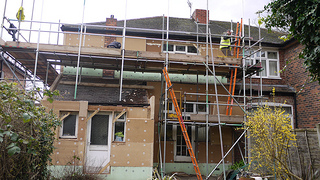
The aim of whole house retrofit is to specify, design and detail a set of complementary bespoke measures to create a single, interlocking whole house approach to retrofit. Particular care is taken in the design and delivery of Whole House Retrofit works to avoid thermal bridging occurring and to maximise air tightness.
The exact specification of the measures appropriate to each household is dictated by building fabric, cost, where applicable, ECO funding arrangement, and householder lifestyle and preference. Some of the recommended measures are:
- External wall insulation (as appropriate often at side and rear of property), e.g. 180mm thick Unger-Diffutherm woodfibre (for vapour permeability and all round sustainability)
- Internal wall insulation (as appropriate, often on front elevation), eg 125mm vapour permeable Unger-Diffutherm woodfibre internal wall insulation
- Replacing existing windows with Eco-contract ULTRA triple-glazed timber windows from Green Building Store (U-value 0.79 W/m2K).
- Insulated timber external doors.
- New gas A-rated condensing Vaillant combi boilers
- Aereco demand-controlled passive stack ventilation systems to improve and stabilise internal air quality while minimising energy use
- Loft insulation top up to 400mm
- Floor insulation: 200mm wood fibre insulation between joists
- Air tightness works
- High efficiency solar photovoltaic panels to generate electricity
- OpenEnergyMonitors – to track electricity usage, temperature and humidity
Open Energy Monitors

Related to the assessment, monitoring and evaluation of household energy performance, we have been collaborating with the open source hardware and software project – OpenEnergyMonitors. The monitors provide a technical solution to the problem of baselining energy performance and evaluating measures but the open source, DIY nature of the project means they provide an excellent engagement tool for individuals and organisations around household energy.
We collaborate with OpenEnergyMonitors on a number of projects including a monthly MeetUp in Manchester, Eco-home Lab, and, along with Bristol Energy Co-op, an EU-funded project to test the viability of community owned energy supply in smart grids to explore the management and moderation of demands on energy.
Go Early/Community Green Deal

In the summer of 2012, using the 'Go Early' programme, DECC commissioned Carbon Co-op to test out the concept outlined in the Community Green Deal report, and to act as an intermediary to assist householders around Greater Manchester in achieving 2050 energy standards through whole house retrofit.
This groundbreaking project involved :
– the recruitment of householders from the existing membership and new outreach activities such as eco-home bus tours (The households are all domestic, owner occupied properties ranging in size from 90m2 to 198m2. They are distributed around the Greater Manchester region taking in a range of housing types to ensure the lessons learned in this programme are widely replicable for future roll out.)
– the delivery of 40 whole house assessments
– design, development and specification work from URBED (specifying measures, processes and materials, working up design details to form a full package),
– the provision of zero interest loans to householders to the value of £244,000 (by Street UK) and access to ECO (secured from Keepmoat/EDF and administered by URBED) and Green Deal Cashback funds.
– the procurement of works for nine of the homes through a single contract, with Carbon Co-op acting as client and intermediary and URBED providing technical support (tendering the full package of measures for multiple properties with the assistance of the Procure Plus framework in Manchester). In procuring work we implemented a local, ethical procurement policy, materials that minimised environmental impact and where possible local installers and supply chains.
– the delivery of the work by the chosen contractor, Jackson and Jackson, with contract administration from URBED, householder liaison and co-operative development carried out by Carbon Co-op
– as of Autumn 2014, the first eight whole house retrofit homes are complete with monitoring and evaluation work being carried out by University of Salford. Actual savings are dependent on the quality of the installation work and the occupants' behaviour. Post-retrofit monitoring and evaluation will assess performance and influence future choices in measure selection and detailing. These homes will act as best practice exemplars for further retrofit roll out locally.
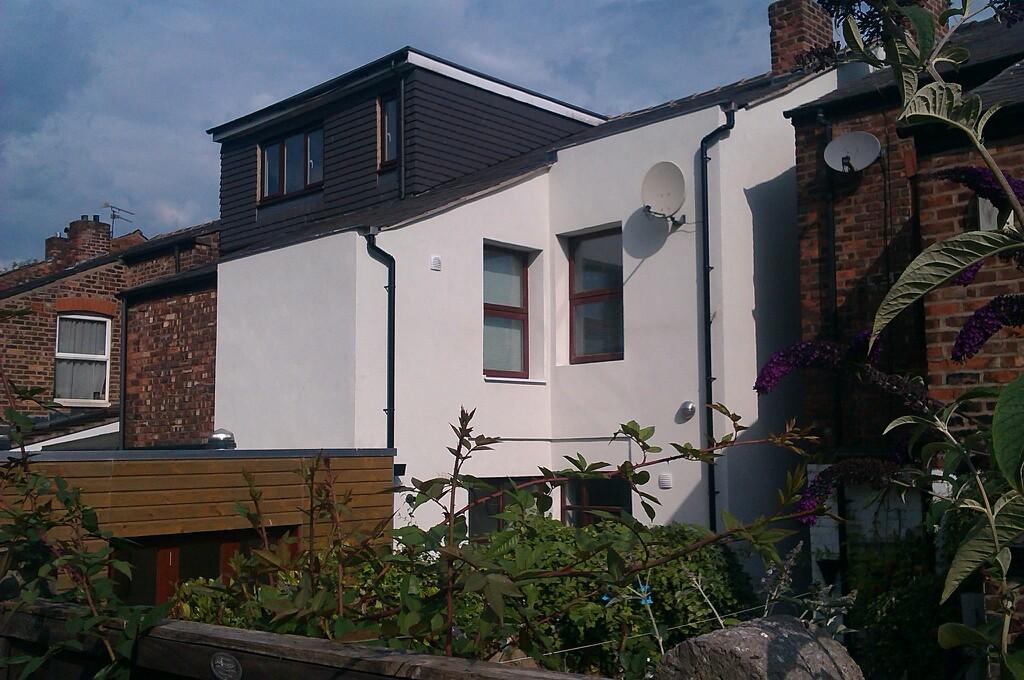
Householders have also benefitted from solar PV panels and as a result are generating income as well as using self-generated energy at certain times of day.
Overall, the project estimates that total energy savings per year of 139,874 Kwh per year (140Mwh/year) and total CO2 savings of 3,1052Kwh/year (31 tonnes CO2/year) will be achieved.
Based on research by DECC, we believe householders can expect an improvement in their home's value.
A priority for future development is to ensure the skills and knowledge accumulated in this project is shared with the wider membership. But this hugely ambitious project also provides a huge amount of learning for stakeholders in government, retrofit, Community Energy and the sustainability sector as a whole.
Retrofitting multiple homes to 80% reduction standards was extremely ambitious, for architects, suppliers, householders and Carbon Co-op alike. The process itself was extremely disruptive for householders and the pros and cons of co-operation and community collaboration were tested throughout. From a contractor point of view the logistics of multiple installations in multiple locations were highly complex. Despite this the completed homes are of a very high finished standard.
Open Eco Homes
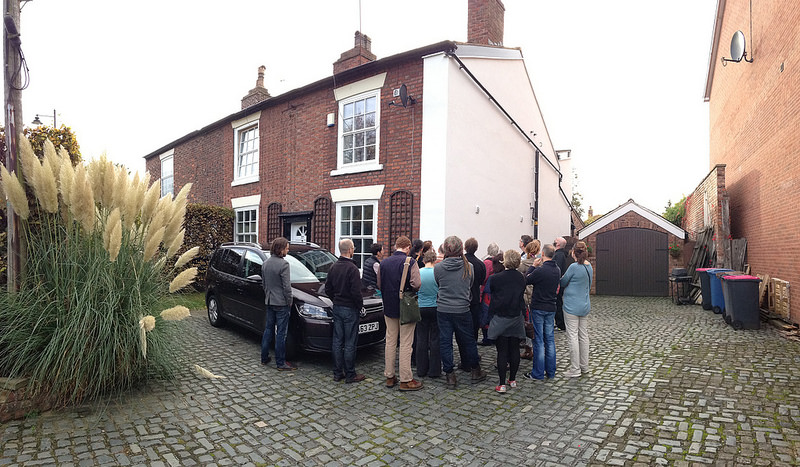
Carbon Co-op regularly organise tours visiting retrofitted eco-homes to showcase the whole house approach and specific improvements to inspire future projects. To date, around 150 people have visited the homes as part of formal and informal open days.
Engagement and recruitment
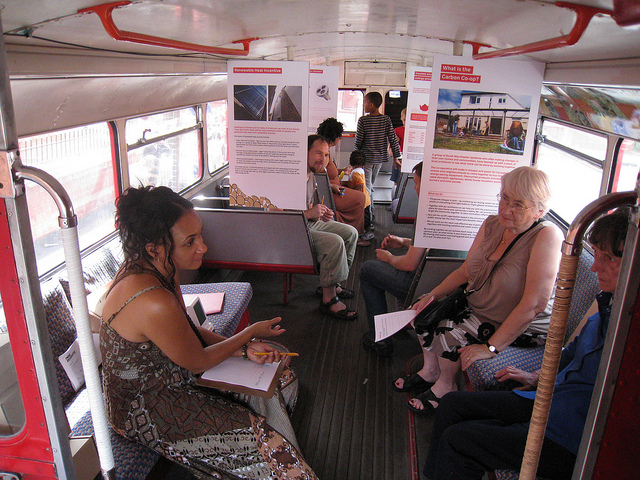
- We regularly speak at conferences and events with an estimated cumulative audience of around 2,000 people per year.
- Our website has attracted over 7,000 unique visitors in the past year and we have over 1,600 followers on Twitter.
- We encourage householders to use energy more effectively by publishing tips and hints on the Carbon Co-op website and newsletters, together with links to other sources of information.
- We run stalls and give talks at public events about the purchase of basic items such as LED lighbulbs or the use of curtains, draft excluders etc and energy switching.
- When considering a retrofit, we can offer OpenEnergyMonitors to track energy usage and environmental data. Information is available to the householder online, and provides both a baseline to measure performance against other homes, and a decision making tool for future investment as well as influencing current energy use behaviour. It also allows follow up monitoring and evaluation.
- After carrying out retrofit, we ensure householders are aware of how to use and operate efficiency measures. Householders are provided with a Handover Pack on completion of the work. This describes the technologies installed and how to use and maintain them.
- URBED and Carbon Co-op field questions via phone and email on the use of measures/performance of technologies
- Carbon Co-op facilitates knowledge exchange among householders, via email, social media, website forums, meet ups and visits to support householders in managing their home.
- Members are encouraged and supported to join the management committee or to participate in a sub-committee eg managing project finances.
- Carbon Co-op also holds members events such as specialist seminars and socials where people can informally raise issues and ask questions. We also carry out regular member surveys with over half the membership participating in the last one.
- We regularly engage with the wider community including individuals – who are free to attend meetings and events – and other community and voluntary sector organisations via a variety of local, regional and national networks.
Unicorn Grocery solar panels
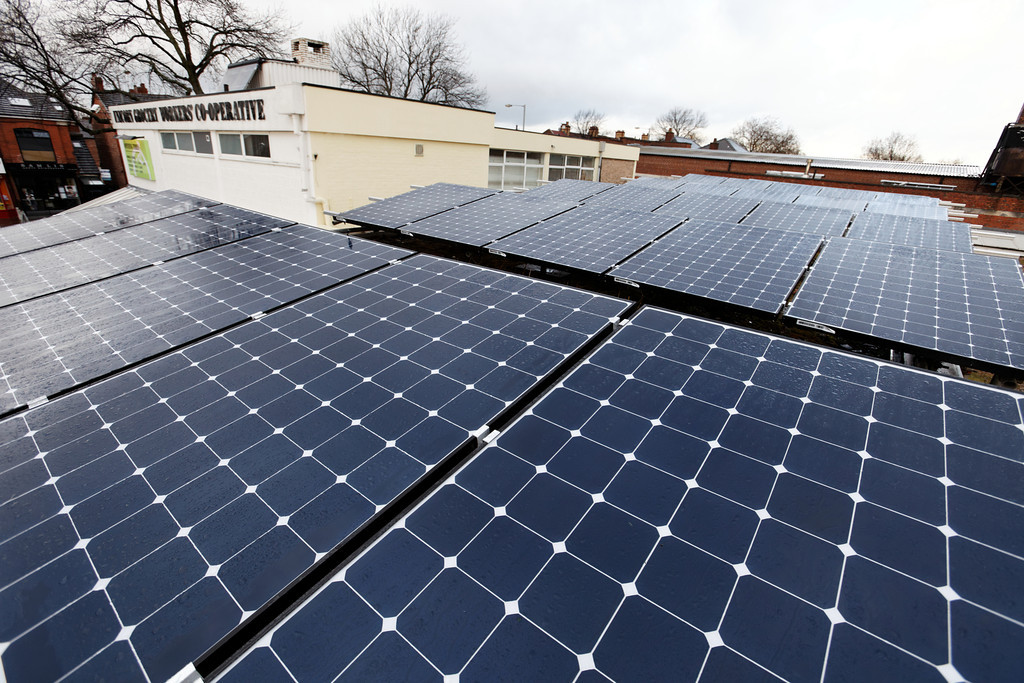
As well as all this, in 2012 we installed a 12kw solar panel array at Unicorn Grocery, a wholefood co-operative based in South Manchester. Our solar PV installation at Unicorn Grocery in Manchester benefits the 50 members of the worker co-op's staff as well as the estimated 4,000 regular customers. The annual CO2 savings are estimated to be 4.5 tonnes per year.
What's next?

Carbon Co-op and URBED combine the best in participatory community engagement with some of the UK's leading expertise in whole house retrofit.
We will use the whole house retrofit homes as open home exemplars in order to inform and inspire future householders.
The Go Early/Community Green Deal project has delivered much learning in terms of technical performance, supply chain capacity and managing householder expectations and we expect to be able to incorporate this learning in to future projects as well as share this with appropriate networks around the UK.
In particular we will seek to use different procurement routes for different aspects of the retrofit works, eg smaller measures such as loft top ups delivered by local builders, larger ones such as woodfibre EWI procured by Carbon Co-op using a single contract.
Our aim is to empower householders to participate in the retrofit process more actively and retain more control – running information and awareness seminars, webinars and producing information sheets.
Our ambition is to collaborate with similar organisations to enable more Community Energy organisations to deliver demand reduction and whole house retrofit works.
We are also seeking an effective way to deliver work in areas of fuel poverty.
Changes to government policy present the biggest threat to the energy efficiency sector as a whole. Changing government incentives such as ECO and Green Deal Home Improvement Fund confuse consumers and can lead to organisations investing time and effort in developing products and services which are later useless.
In general, problems with the implementation of Green Deal have had a negative impact on the whole energy efficiency sector and poorly installed external wall insulation ECO schemes are a ticking time bomb for the industry. It is essential for Carbon Co-op's offer to remain distinct and autonomous from government programmes to avoid potential reputational damage.
The technical complexities of whole house retrofit continue to limit the size of the sector and present a huge risk for organisations seeking to deliver retrofit at scale. It's important to ensure Carbon Co-op use high quality technical expertise.
We continue to work to overcome the previously identified barriers to retrofit ie assessment, supply chain development and finance.
We are investing in tools to bring down the cost of future whole house retrofit procurement for householders including a database of measures – the Retrofit Pattern Book – and engagement with supply chain companies.
In terms of finance we are exploring collaborations with finance providers such as building societies, social enterprise loan providers and local authority home improvement loan providers.
We continue to engage with and lobby government and energy companies in an effort to influence the development of future policy and retrofit incentives.
In addition to our energy efficiency work we also facilitate the Fuelling Manchester – Community Energy network for Greater Manchester and are delivering a crowd sourced Community Energy Strategy for Greater Manchester.