
Introduction
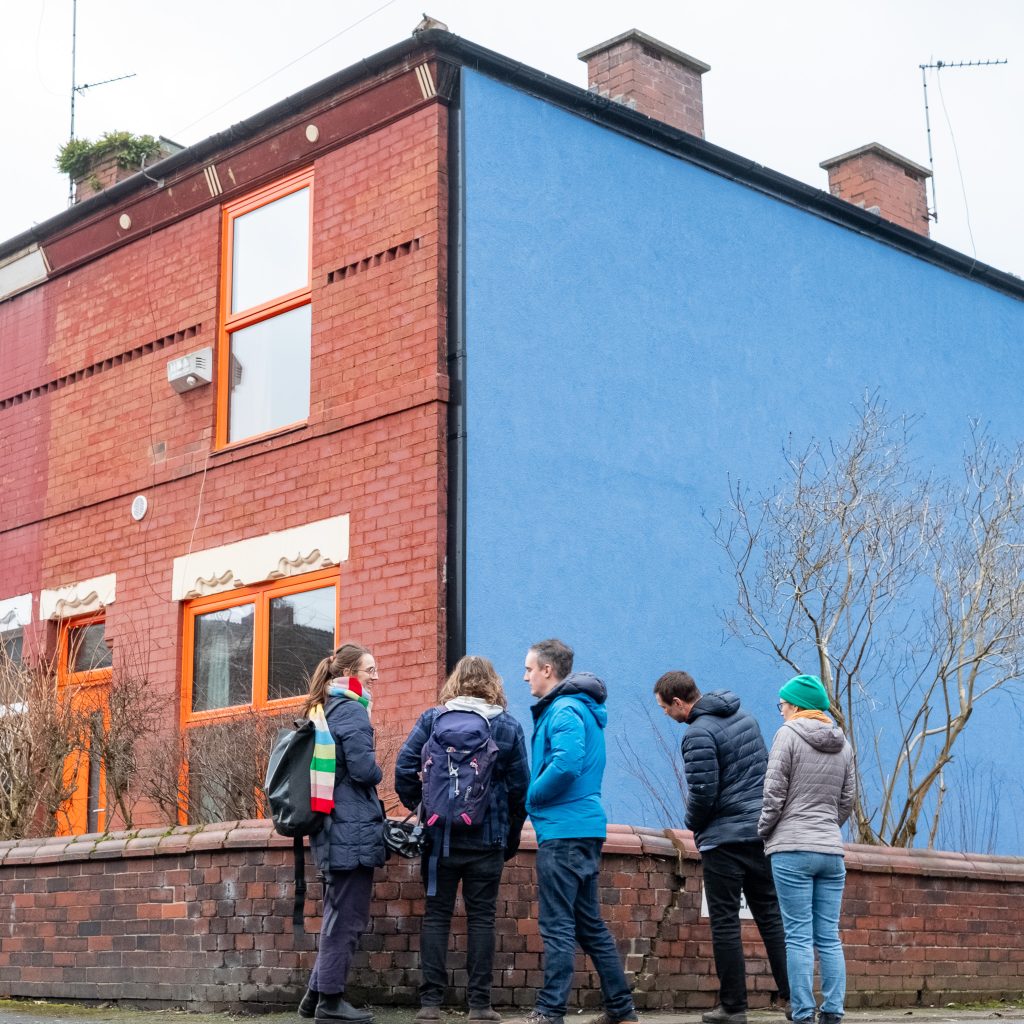
The goal of Manchester-based Carbon Co-op is to radically reduce domestic carbon emissions for people and communities using approaches such as ‘retrofit’ works (domestic upgrades or installations that improve energy efficiency). Carbon Co-op have recently coordinated an Area-Based Retrofit scheme in Levenshulme, South Manchester, making use of the efficiencies gained by working on multiple nearby properties of the same type. This article will establish how the finance of the project has worked and what Carbon Co-op have learnt from the process, leading to useful considerations for the design of new area-based schemes.
We will focus here mainly on resourcing capital costs i.e. the cost of retrofit works including materials, labour and any costs like architect fees and inspections. Whilst there are also programme costs to consider in the context of an area-based project, ensuring capital works are funded is key to making the whole scheme work.
Blended approach
A fundamental challenge of any area-based scheme is that householders all have different circumstances, needs and ambitions – and the properties themselves are in differing conditions, even if they are on the same terraced street. The task is to balance these with a finance offer that works for a wide range of people. In the case of the Levenshulme project, Carbon Co-op have taken a blended approach made up of three funding elements: grant funding, loan finance (with support from Manchester City Council), and contributions from homeowners.
Role of grants
The grant pot for this project was funded out of accumulated loan re-payments from Carbon Co-op’s 2015 Community Green Deal deep retrofit project. 0% loans were made available to fund retrofit works for householders participating in this earlier project, funded from the Department of Energy and Climate Change (as it was then known), with the caveat that the later repayments must be dispersed as grants to individuals experiencing fuel poverty. 10 years after that project around £200,000 of capital is now available to grant out.
As a result there are two fully grant funded projects in the area-based scheme. Partial grants have also been given to subsidise certain works in the other properties using an eligibility test similar to the ECO flex criteria. These properties have also made differing levels of personal contributions; some have chosen to invest more than others so that they can benefit from additional home improvement works beyond the core retrofit improvements. whilst one has kept within their grant, which covers the core works including:
- EWI to the rear of the property and gable end as appropriate, with associated roof works
- triple glazed windows and door to the rear
- loft insulation
- mechanical ventilation
- draught-proofing
- enabling works specific to the property.
Role of loans
There are a multitude of loans available for home renovation including mortgage, secured and unsecured products, which may be more or less appropriate for an area-based scheme of this nature. In the case of the Levenshulme project, Manchester City Council are a key project stakeholder partner and had historically offered a ‘Group Works Assistance’ loan product designed for area-based construction works. This product falls under their Home Improvement and Relocation Assistance Policy, which provides financial assistance to owner occupiers invited by the Council to participate in specific targeted schemes within geographical areas. Manchester City Council has historically provided Group Works Assistance to Right to Buy property owners for similar area-based schemes.
When undertaking improvements, e.g. re-roofing + solar PV installations across a terraced street, a ‘Group Works Assistance’ loan would be offered to any ‘pepper-potted’ owner-occupiers to enable them to participate, achieving economies of scale, lower cost to those householders, alongside improvements to carbon emissions and/or the visual environment. Loans like these are not commonly available to members of the public and the availability of Group Works Assistance loans within a specific area needs to be explicitly designated by the local authority offering it. The Levenshulme scheme required a Manchester City Council governance process to approve.
The Group Works Assistance loans used by Manchester City Council take the form of ‘registered charge’ loans which are set against the legal title. The loan only needs to be repaid on change of ownership (sale or inheritance of the house), and they do not accrue interest, although there is an administrative charge to cover Council expenses. The amount of loan is agreed on a scheme by scheme basis and takes account of what works are required and the cost of those works. In the case of the Levenshulme area-based project the initial limit was £20,000, but was increased to £35,000 as actual scheme costs were established. Most participants opted for the maximum amount, although some have chosen smaller loans.
Benefit to this type of loan
Lending of this kind uses capital from local authority reserves and can be more flexible than day-to-day revenue spending because the charge on the house is categorised as a council-owned asset. Carbon Co-op are talking to other local authorities interested in taking this approach, as it has proved to be an effective localised lending mechanism that has the potential to generate local economic development benefits – in particular when linked to effective local procurement and supply chain development.
Drawback to this type of loan
This type of loan is only available to owner-occupiers who meet specific criteria, e.g. with sufficient equity in their home. Although the product constitutes a good deal for householders and an effective tool to enable area-based construction, it requires an administrative process and coordination between different parties and multiple householders, which risks delays. The requirements of the loan meant Carbon Co-op had
Other types of loans
The Group Works Assistance loan scheme was only possible in Levenshulme because the Council was a strategic partner on the scheme, they had an existing policy in place that allowed them to offer the loan and at the time of the project, was able to identify funding to support it. Many local authorities have previously issued simpler unsecured Home Improvement Loans (in fact Manchester City Council still do). However, these have become scarcer in the past decade of austerity and financial strain on local authorities.
The Green Finance Institute are investigating property-linked finance approaches in which the loan is tied to the home and repayment is passed onto the next householder.
Other interesting developments in this area are being explored in the UK government’s Green Homes Finance Accelerator programme, with Carbon Co-op a partner on a Credit Union-led One Stop Shop project. This project has identified localised, co-operative lending schemes in the US and Ireland in which members have shown a preference for unsecured, interest bearing loans from credit unions over grants made available from government due to increased trust and accountability offered by a Credit Union, access to localised supply chains and a fear that contractors operating government grant programmes can be overpriced and of poor quality.

Flexibility
A key learning from the area-based scheme is that enabling works are often required to facilitate retrofit works but often excluded from government schemes. For example, walls need to be in a good state of repair before solid wall insulation is applied, roofs need to be able to bear the weight of solar panels, etc. A flexible loan product means that basic repair and maintenance can be carried out to enable retrofit improvements.
Furthermore, building trust is critical with retrofit, which is both disruptive and complicated, and even more important in a group project. It is important to put in the time and resources to ensure participants understand how a high quality of work will be ensured, and have realistic expectations of the disruption involved, especially with those in fuel poverty who may be more likely to experience other life challenges and need additional support.
Programme costs for the Levenshulme project were invested in a range of areas such as local area profiling, archetype identification and development and community engagement. Significant support for monitoring and evaluation came from Carbon Co-op’s Horizon Europe EBENTO project and an award from the MCS Foundation has enabled the scheme to involve training workers and apprentices – you can read more about this here or in detail here.
Funding for any effective retrofit programme should be flexible to cover the time cost of householder engagement and support, with Carbon Co-op committing the equivalent of 1-2 days per week on engagement and support in the recruitment and pre-development stage. Many Government grant programmes have inflexible criteria which lead to householders dropping out and therefore do not lend themselves to a collective, area-based approach.
Conclusions
Academics such as Brenda Boardman have observed that the more restrictive criteria that are set in place for a scheme or programme, the greater the dropout rate and the more that the benefits of collectivised programmes are lost – from contracting and cost reductions to peer support and neighborhood word-of-mouth increasing uptake and involvement.
A blended approach of grants, loans and householder’s own contributions, alongside personalised support, helps to meet the varying needs of householders whilst maximising flexibility and involvement, enabling an area-based approach.
The specific products and sources of capital used in the Levenshulme ABS are not necessarily a template that can be copied for every area in the country. But the deployment of capital via a Local Authority has the benefit of ‘going back to the future’ and utilising localised networks and stakeholders to enable retrofit to take place at scale and could be replicated with appropriate government support and underwriting.
Thanks to Harlow Consulting, the authors of this blog.
