
Over the last year we’ve been increasingly asked about grant funded programmes for retrofit. Do we recommend them? Do we refer people into them? So we’ve done a lot of thinking about what our position is, because we want to provide clarity to our staff and the households we talk to. This blog post sets out our position, at the moment. We envisage that we’ll need to revisit this from time to time, as our organisation and services grow, and as external factors change.
What do we mean by grant programmes?
To clarify, when we talk about grant programmes, we’re talking about large publicly funded programmes, i.e. those that originate from a public body such as national or local government. Examples of this include the Energy Company Obligation (ECO), the Boiler Upgrade Scheme and the Warm Homes: Social Housing Fund.
Grant giving may happen in other settings, for example, via charitable foundations – but these grants are often smaller, very specific in their remit or a one-off. It’s also important to note that grants aren’t the only funding available. Households also borrow money to fund energy improvements.
So what’s the problem?
We know from experience that grants and funding schemes can be:
- Challenging for householders to access (e.g. due to complexity or digital barriers).
- Challenging to deliver (meeting eligibility criteria, evidence requirements, timescales).
- Deliver poor outcomes for households and organisations (including their experience of the process, but also poor quality work).
At the most acute end of scale, grant funded retrofit programmes done badly have severely damaged the health of occupants and worsened the condition of homes. One of the most well publicised schemes in this respect is the external wall insulation programme in Fishwick, Preston (now receiving rectification works under the leadership of charity National Energy Action). But just last month the Department for Energy Security and Net Zero (DESNZ) issued a press release concerning ‘widespread cases of poor-quality solid wall insulation installed under inherited ECO4 and GBIS’ schemes. And the Building Safety Act exists because of huge failings (across building and housing management industries) that led to devastating loss of life at Grenfell.
However, it’s important to also acknowledge that many people will have benefited from grant funded works and these case studies are often less prominent.
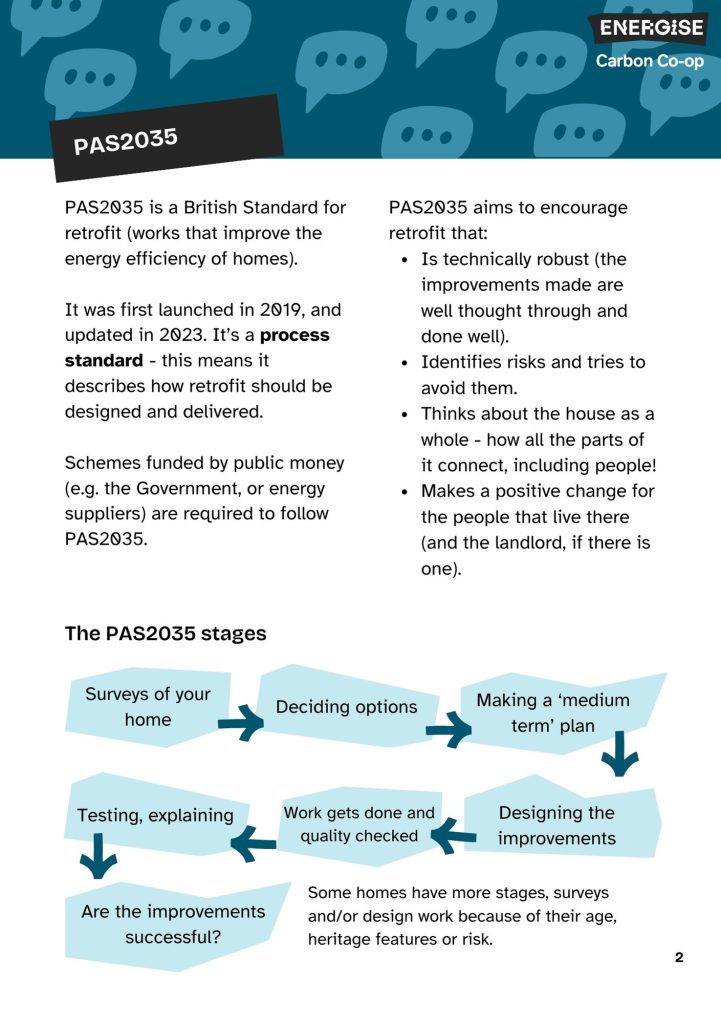
While some would argue that we now have a better framework of retrofit standards (such as PAS2035, which flowed from the ‘Each Home Counts’ review in 2016), we know from direct experience that these are not always consistently applied or followed, and do not always lead to quality outcomes for many reasons.
We think that some of the issues are shaped by ‘structural’ challenges that are baked in at a policy level. For example:
- Sometimes conflicting aims and metrics – e.g. saving carbon vs reducing fuel poverty.
- The use of Energy Performance Certificates (EPCs) as a measuring stick.
- Appropriateness – what a person is eligible for via a grant scheme is not always what is most appropriate for their home, their circumstances or priorities. This can lead to inappropriate recommendations, lacking context and professional expertise.
- Cherry picking of easier or less complex homes – often driven by targets, cost efficiencies and time pressures. This has implications for energy justice because some households (especially those more vulnerable or with complex lives) get left behind. It also creates barriers to engaging households on retrofit in future, because they think their home is not suitable at all, or that their time was wasted previously.
Quality and the performance gap
We know that there is often a gap between how homes perform in practice (in energy savings, but also more complex outcomes like comfort), and what was intended at the design stage. There are several reasons for this – including the quality of the works (shoddily installed insulation will have higher heat loss etc), but also the gap between what standardised energy models assume (these underpin EPCs), and what a household actually uses in reality.
There can be many reasons for poor installation quality, including a lack of training and skills within installers, lengthy supply chains (e.g. where work is subcontracted several times) and with a lack of oversight, and procurement frameworks that squeeze quality through a preference for lowest cost.
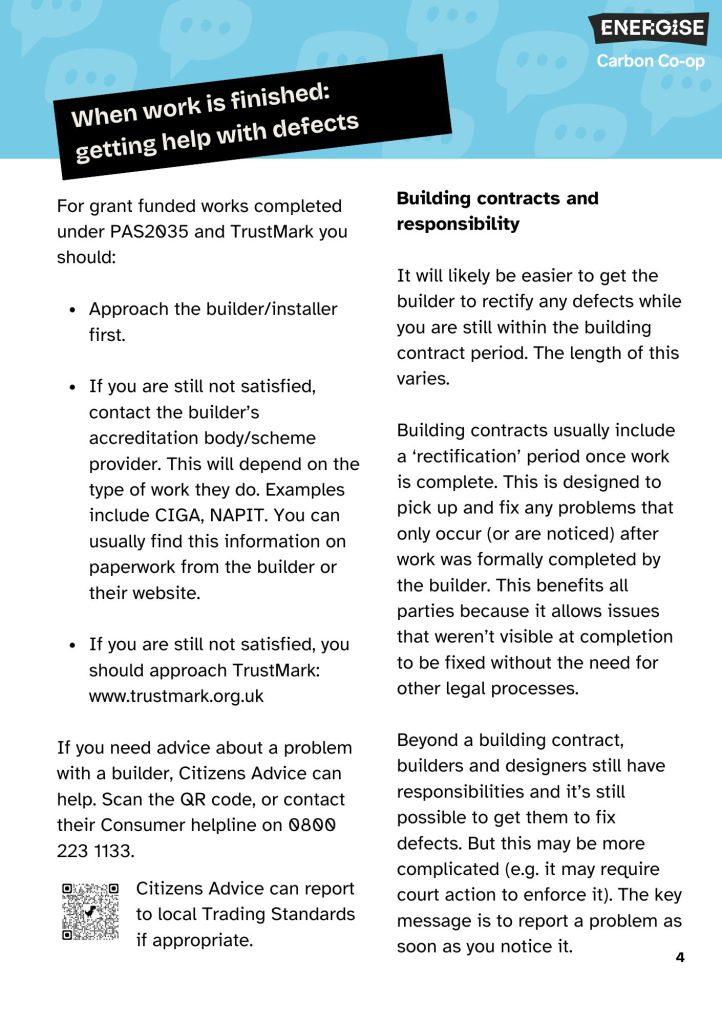
While government backed schemes like TrustMark aim to offer more consumer protection, and installation standards like PAS2030 now exist, having these ‘certifications’ or stamps of approval is not always a guarantee of quality.
This does not mean to say that we think all grant funded work is poor quality and that people should be wary of all installers – but we want to support people to think about quality, have a basic idea of what to look for and question if needed.
People centred?
Many grant funded programmes offer householders very little say over the works, how they are done, or the materials used. Many times householders are made to feel that they should be happy to get a grant at all. Or that it’s a ‘no brainer’ to accept works that come via a grant scheme. A lot of the time householders also don’t have the knowledge and/or confidence to question an approach or point out issues.
Process standards such as PAS2035 (now used across all publicly funded programmes) attempt to rectify this to a degree by requiring advice is given across all the stages of a retrofit, and formalising roles (including Retrofit Coordinators). In the 2023 updates to PAS2035 there are positive further requirements around in-person visits and recording of evidence by a Retrofit Coordinator. However, the specific role of a Retrofit Advisor has been removed – so whilst advice is still considered important, it can be delivered by other roles (including the Installer). There are also concerns that the cost of complying with such standards is a challenge for the supply chain.
What are the implications of this for our messaging on grant schemes?
Our overall position at Carbon Co-op can be summarised as – we want to empower householders to:
- Understand the scope of grant schemes, their potential benefits but also limitations and risks.
- Understand where a grant scheme and the measures it offers might be appropriate for their home and priorities.
- Understand what quality might look like and how to ask about it.
Ultimately we want householders to be able to make more informed decisions.
We won’t:
- Endorse or promote particular grant schemes. This includes not participating in activities like doorknocking with contractors, or allowing contractors to attend events and training we host as part of lead generation.
- Act as a referral partner or directly refer householders into grant schemes. We value our role as a trusted community intermediary and don’t want to jeopardise this.
- Handhold householders through applications and delivery of grant schemes. We will give generalised advice on how to navigate and assess the benefit of these schemes, but we don’t currently have the capacity or set-up to offer one-to-one guidance.
We will:
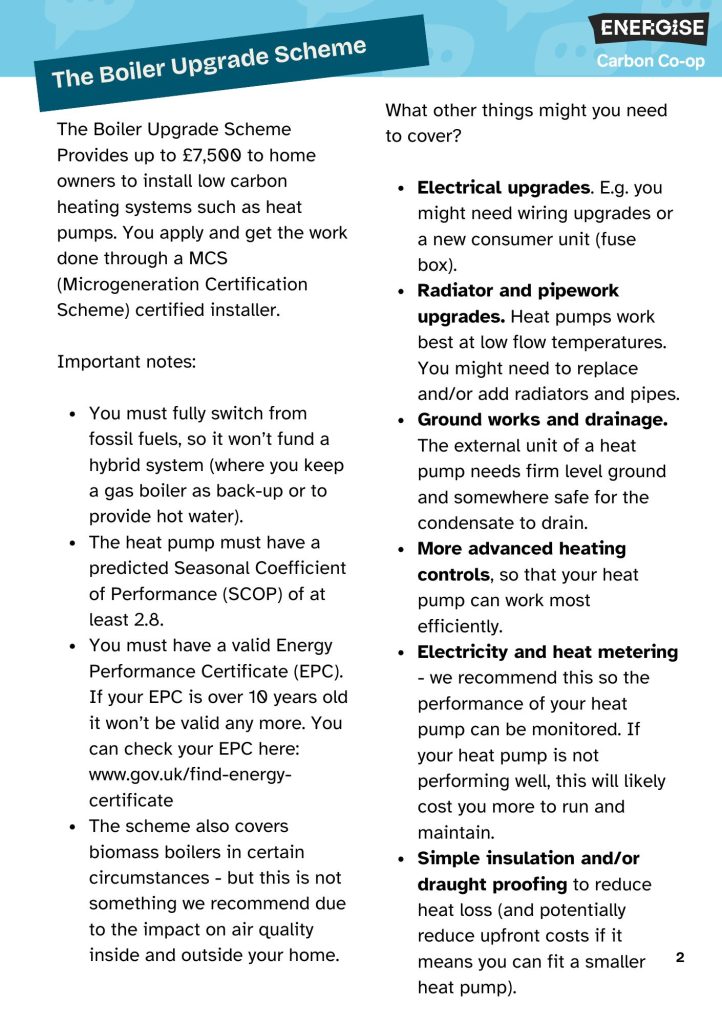
- Make householders aware of the Boiler Upgrade Scheme if they are considering a heat pump. This is often the case for our Carbon Co-op membership base. However, if a householder is considering a heat pump, we will advise them about sensible preparatory works or surveys to ensure it is appropriate. This might include:
- Consumer unit (fuse box) and wiring upgrades,
- Radiator and pipework upgrades,
- Control upgrades,
- Simple fabric insulation to reduce bill costs (and potentially install costs by requiring a smaller heat pump).
- Signpost householders to where they can obtain further information about a grant scheme, especially if they raise the subject with us. However, this is with the caution outlined above. We do this because whilst we won’t directly refer to (or endorse) schemes, we understand people often want to check if a company is part of a local authority scheme or access more information themselves.
- We’d like to provide basic information on consumer protection steps and principles, and we’re keen to look at the work of organisations like Citizens Advice in developing this.
- Continue to engage with programmes like Warm Homes: Social Housing Fund via our links with housing providers. But this is with the intention of conducting research, providing insight and tools that can help them to deliver more householder centred, and better quality schemes. We’ll only fulfil advisory and complementary roles (such as around engagement, monitoring and evaluation), and we will not fulfil direct delivery roles around recruitment, design and installation in particular.
- Continue to explore avenues for policy engagement and influence, including through projects such as Retrofit for All.
What does this look like, practically?
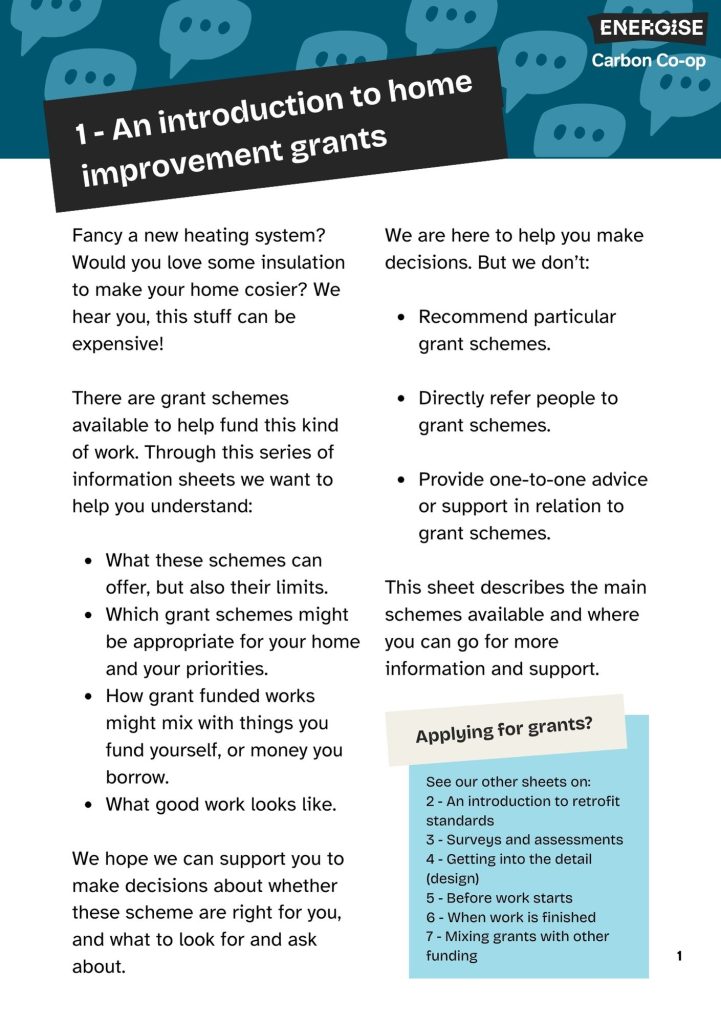
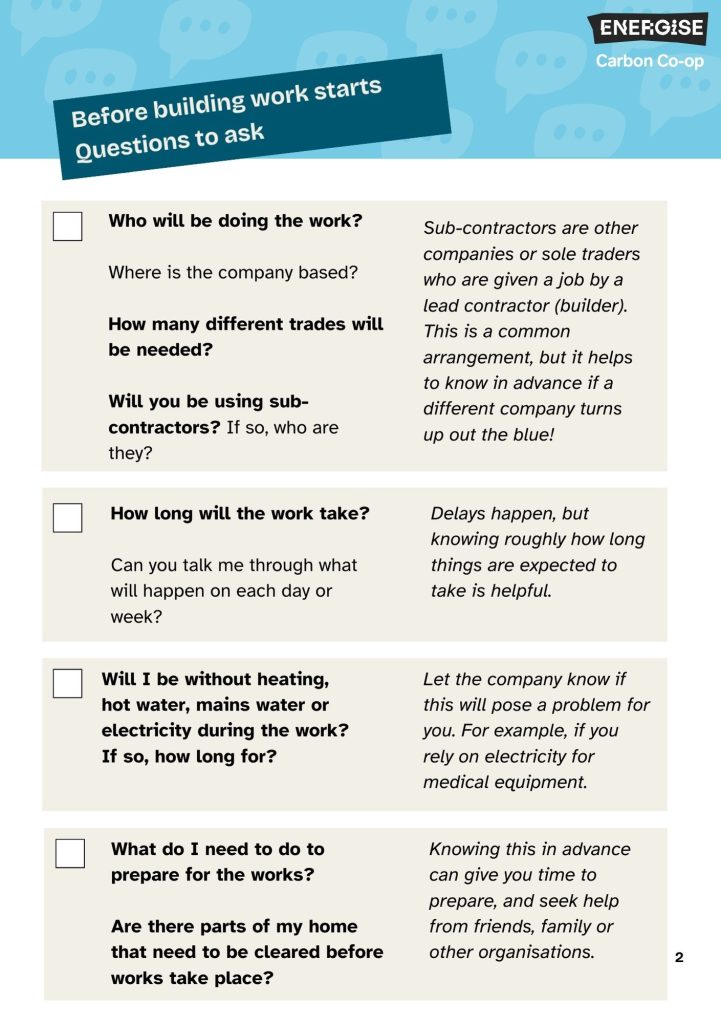
As a starting point we’ve developed a set of information sheets around engaging with grant schemes. Once we started writing we quickly realised that one factsheet wouldn’t do this justice! We’ve therefore developed a series of linked sheets that we can add/change over time. We’ve structured these to cover general concepts, as well as the key stages that a household will pass through when getting retrofit works done. The final sheet is designed for people thinking of blending a grant with another source of funding (like a loan or their own savings). However, this also includes general pointers on things that might fall outside of a grant but they might need!
You can find these sheets here: https://carbon.coop/energise-manchester-handy-resources/
We know these will not be perfect and the world of grants is complex, so we’re very open to suggestions for how these resources can be improved.
In terms of next steps, we’re keen to understand if this resonates with other organisations and build our understanding of what householders need and find useful. If you’re interested in our information sheets, or any of these themes, please get in touch! info@carbon.coop