
Summer 2025 saw the much anticipated completion of construction works on homes in the first phase of the Levenshulme Area Based Scheme (LevABS). Whilst this was undoubtedly a big milestone for householders and partners, work doesn’t stop once tools are downed on-site, and we were keen to ensure that householders have the information they need to make the most of the retrofit works now and in the future (and for potential future occupants).
Handover
Handover is a defined stage in construction projects. It’s where the project is officially ‘handed over’ to the client and end users. In the case of our community intermediary led model, these terms are multi-faceted, with Carbon Co-op the client in some senses (e.g. to our designer and contractor), and householders the client in others. The RIBA Plan of Work helpfully summarises the key outcomes of handover stage as ‘where the building is handed over, aftercare is initiated and the Building Contract concluded.’
Planning for handover commenced a few months before, as this stage can often be neglected, hurried or suffer from the inevitable turbulence of the construction programme. Aneaka, who acted in the Resident Liaison Role at Carbon Co-op, worked closely with Helen (who’s done lots around handover materials on previous retrofit and new-build projects) to coordinate this activity. The project architect Julie Maxwell at Progress in Practice was liaised with closely and provided valuable review. Retrofit designers have key responsibilities at this stage, for example, collating a ‘Health and Safety File’ for each home – a requirement under the Construction (Design and Management) Regulations 2015.
Handover objectives
Our objectives for handover were threefold:
To maximise the benefits of the work for householders
Householders understand works undertaken to their home.
Householders know how to maximise the benefits of retrofit measures installed, e.g. using ventilation system and heating controls efficiently.
Householders know how to undertake basic maintenance, and maintain the integrity of the retrofit works when doing future home improvements or repairs.
Householders can access and understand energy and environmental monitoring data.
Complete and well organised documentation
Householders and Carbon Co-op have access to documentation related to works undertaken.
Householders understand any relevant information re guarantees/warranties.
Clear aftercare process and understanding of responsibilities
Householders know who to contact regarding any issues arising post works.
Carbon Co-op and householders are clear on lines of responsibility and scope regarding issues arising post works.
The information needed to support these includes:
- Information relating to other (non-physical) aspects of the scheme, such as the Manchester City Council loan funding (where applicable).
- Supporting drawings, such as details for lofts, wall junctions, windows etc.
- Technical information – for example, manufacturer and supplier datasheets, manuals.
- Health and Safety File.
- A more user friendly Home User Guide.
Home User Guide
Time was invested in a more user friendly home user guide for a few reasons:
- manufacturer literature often falls short for householders (and even professionals!). While some householders are perfectly content to wade through reams of technical literature, or interpret technical diagrams, this does not work for everyone, and they still need to know the essentials.
- It can brings together different components, so householders can see how they interact with each other and slot into a ‘bigger picture.’
The aim is not to replace the original sources of information, but to complement them in a more accessible way. This approach included:
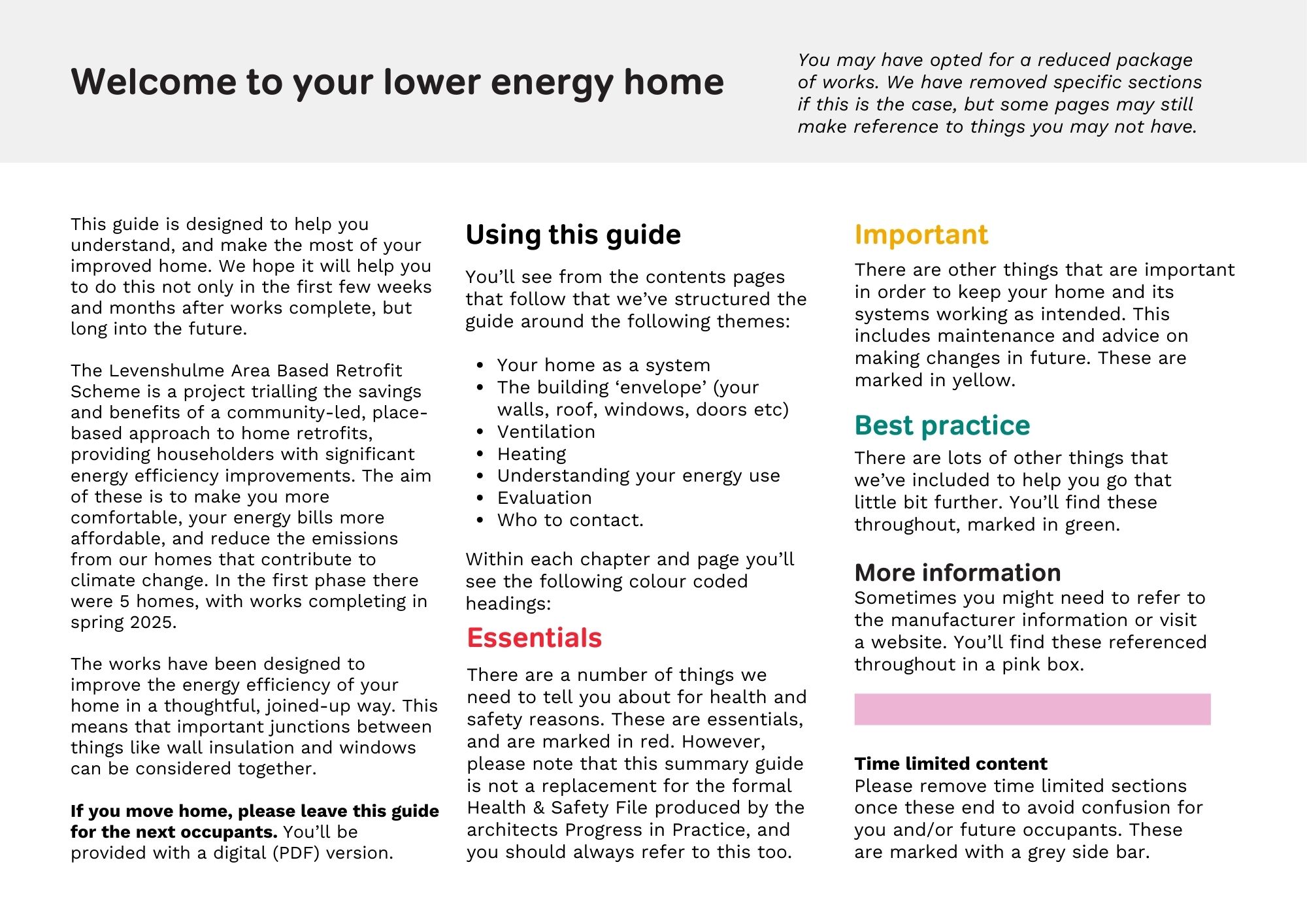
Introductory and contextual information – particularly important where a scheme has facilitated a first phase of retrofit works on a home, working towards a longer term whole house plan. LevABS households had been immersed in the scheme for a long time by this point, and arguably know much of this already, but it is helpful to refer back to, or pass on to future occupants.

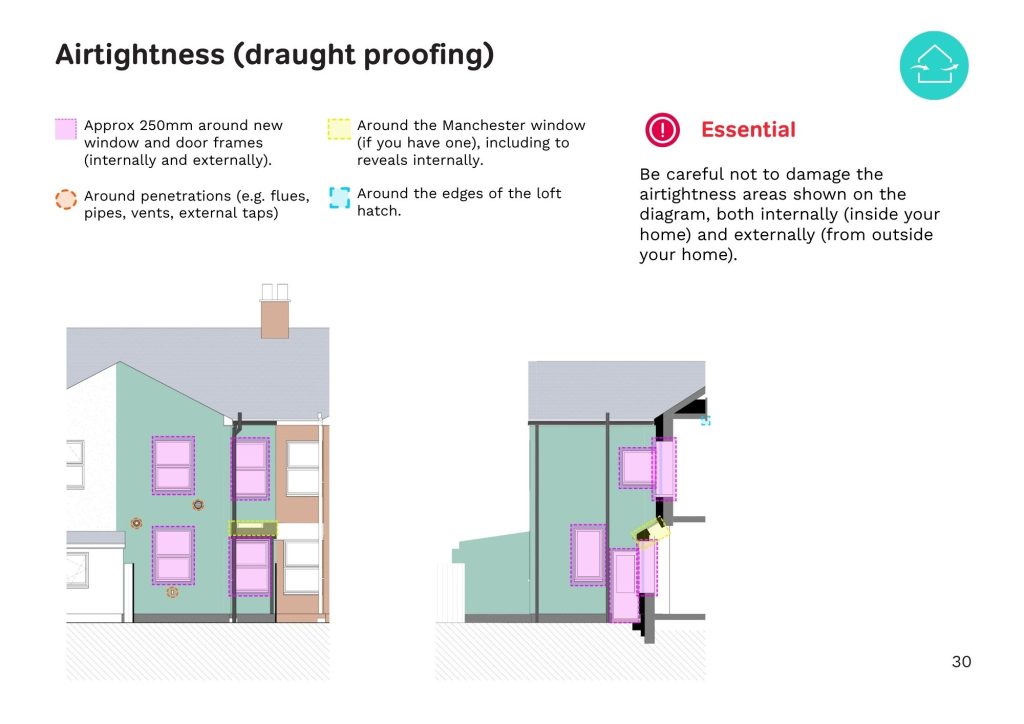
Providing photos, diagrams and simplified descriptions of key components.
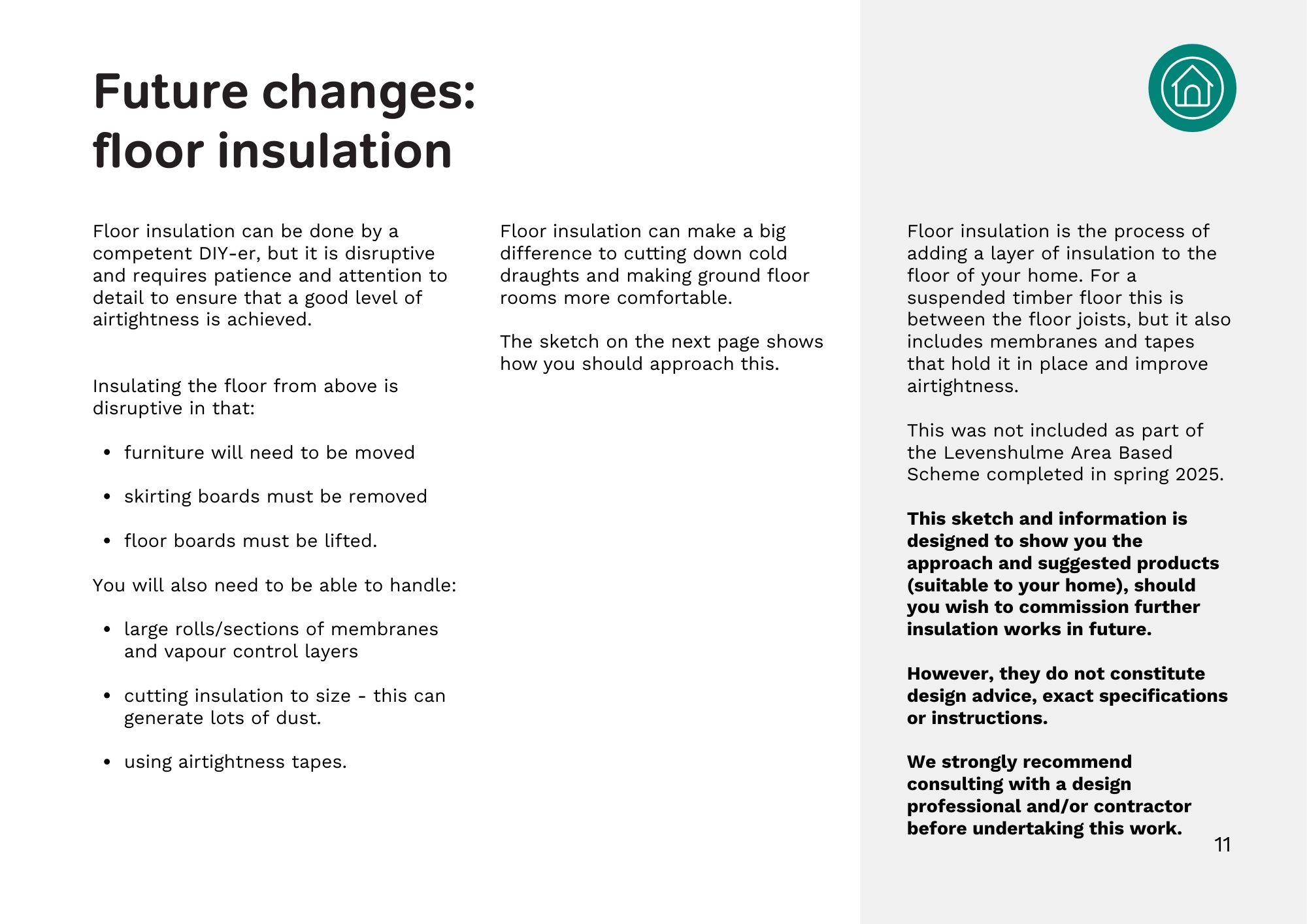
Providing some advice on specific future improvements – such as internal wall and suspended timber floor insulation. This is a delicate balance and caution is needed where further design work might be required (such as assessing moisture risk and detailing junctions for internal wall insulation).
Coding information – from the essential and important things, through to good practice and further reading.
Bringing product information together in an index.
For this first ABS scheme a master document was created, which was then tweaked slightly for each home depending on the measures received. This went as far as including the RAL codes for render, window and door colours, should they need to be touched up in future. This was feasible with a scheme of 5 homes, but would arguably need to be automated or streamlined on future scaled up programmes.
Putting guides together has also highlighted information or process that need to be established earlier in the programme. For example, there would be value in consolidating the defects process earlier as it requires a degree of coordination between different partners. Checklists and site visits could also be integrated more with the production of handover materials.
In-person handover meetings
Each household was visited once they’d had chance to familiarise themselves with handover information. These meetings have generated lots of learning already, with undoubtedly more to come.
This has highlighted content that doesn’t work so well, or other things that would be helpful in the guide. Some of the questions have been very practical, such as: how to protect the render finish if they need to put a ladder against external wall insulation; or where replacement ventilation filters can actually be sourced from (not as straight forward as we hoped!).
Other learning has been around signposting and further support, particularly when it comes to possible next phases of works – with some householders interested in heat pumps or further insulation. This gives us lots to think about in terms of how schemes like this sit within our (Carbon Co-op and wider partners) organisational services, and the journey for householders in a phased retrofit context. Further phases of Area Based Schemes, as being actively explored by Carbon Co-op in Manchester and beyond, will move us towards our ambition for best practice around this important stage in retrofit projects.